Adjusting the rear seats
The rear seats in the Kia Opirus (2003–2012) offer electric adjustment, seat heating and integrated head restraints. This brings a level of comfort to the rear that is otherwise found only in the luxury class. With the integrated pass-through hatch, long items can also be transported safely. This versatility makes the vehicle the ideal companion for both everyday use and travel.
Adjusting the rear seats forward and rearward*
The rear seats can only be adjusted with the ignition switched on.
Press the front part of the switch to move the seat cushion forward. At the same time, the rear seatback tilts rearward.
Press the rear part of the switch to move the seat cushion rearward and return the rear seatback to an upright position.
To make it easier to enter through the rear doors, a rear seat that has been moved forward moves automatically rearward when the rear door is opened. When the rear door is closed afterward, the rear seat does not automatically return to its previous position. Readjust the rear seat position if necessary.
NOTE
Do not keep pressing the button once the rear seat has reached its maximum forward or rearward position. Components of the electric seat adjustment could be damaged by prolonged operation of the switch.
WARNINGTake care that hands or objects cannot become caught in the adjustment mechanism when adjusting the seat.
Do not adjust the seat while wearing a seat belt. If the seat were moved forward, strong pressure could be applied to the abdomen.
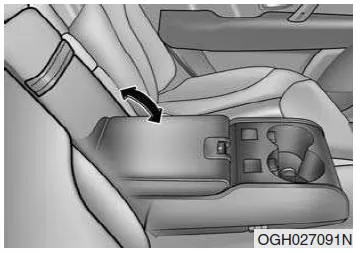
Armrest
The armrest is located in the center of the rear seat. Pull the armrest out of the rear seatback if required.
Depending on the equipment variant of your vehicle, there is a storage compartment and cup holder*.
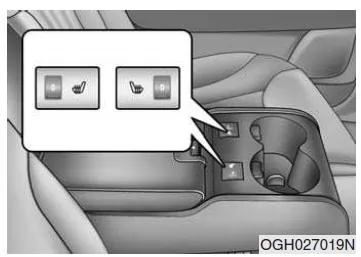
Rear seat heaters*
With the ignition switched on, the rear seats can be electrically heated.
- Pull the armrest out of the rear seatback by the attached loop.
- With the ignition switched on, heat levels 1–5 (5 = highest level) are shown on the switch.
To turn off the seat heater, set the switch to level 0.
The seat heater switches off automatically when the seat temperature reaches the selected temperature.
It switches back on when the seat temperature drops below the selected temperature.
CAUTION- Do not use solvents such as thinner, gasoline, or alcohol to clean the seats. Such solvents can damage the surfaces of the seat heater and seat covering.
- To prevent the seat heater from overheating, do not place blankets, cushions, or seat covers on the seats while the seat heater is switched on.
- Do not transport heavy or sharp-edged objects on seats equipped with a seat heater. The seat heater components could be damaged.
All vehicle occupants should be especially careful when switching on the seat heater, as high temperatures are possible. Use caution if the following persons sit on a seat with a seat heater.
- Infants, children, elderly persons, persons with a handicap, or sick persons.
- Persons sensitive to heat or with very sensitive skin.
- Fatigued persons.
- Anesthetized or intoxicated persons.
- Persons who have taken sleeping pills or other drowsiness-inducing medication.
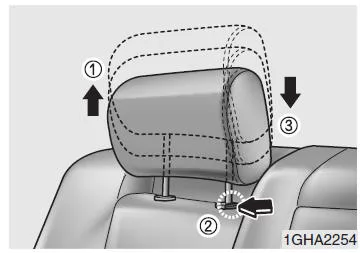
Adjusting the head restraint
Adjusting the head restraint height
The head restraints not only provide comfort, they also support the head and neck in the event of a collision.
To raise the head restraint to a higher position (1), pull it up to the desired position. To lower the head restraint, press and hold the release button (2) and push the head restraint down to the desired position (3).
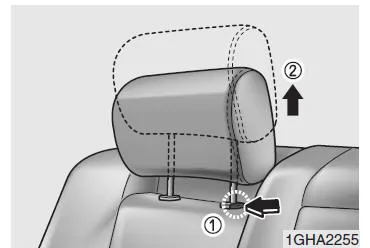
Removing the head restraint
To remove the head restraint, pull it up until it reaches the stop. Press the release button (1) and pull the head restraint upward (2) out of the seatback.
WARNING- For maximum effectiveness in an accident, adjust the head restraint so that the center of the head restraint is level with your eyes. Also adjust it so that the distance to your head is about the width of one fist. For this reason, using an additional cushion that increases the distance between your back and the seatback is not recommended.
- Do not drive the vehicle with the head restraints removed, as this may result in serious occupant injury. When used correctly, head restraints can help protect against neck injuries.
- Do not adjust the head restraint height while driving.
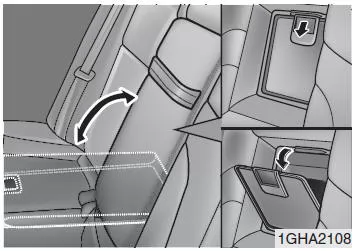
Pass-through hatch*
Pull the armrest out of the rear seatback by the attached loop to access the pass-through hatch cover. Push the locking button downward and fold the cover down to open the pass-through hatch. You can now let longer items such as skis, poles, etc., which normally do not fit in the closed luggage compartment, extend through the pass-through hatch.
WARNING- Always switch off the engine, move the selector lever to Park (P) and apply the parking brake before loading or unloading your vehicle. Otherwise the vehicle could start moving if the selector lever is accidentally moved to another position.
- Secure any items that protrude through the cargo hatch so they cannot shift while driving. Unsecured cargo can damage the vehicle interior and injure occupants.
CAUTIONTake great care when pushing items through the cargo hatch into the vehicle interior to avoid damaging the interior trim.
The rear seats in the Kia Opirus 2003–2011 offer maximum comfort thanks to electric adjustment and seat heating. The well-designed mechanism makes entering easier and provides maximum comfort, even on long journeys.
The integrated armrest and the cargo hatch are particularly practical and make the Kia Opirus versatile – ideal for everyday use and special occasions.
FAQWhat functions do the rear seats of the Kia Opirus 2003–2011 offer?
They are electrically adjustable, optionally heated and equipped with a practical cargo hatch.
Why is it important to use the cargo hatch correctly?
It allows longer items to be transported safely without compromising the safety of the occupants.
Test yourself
A quick Kia Opirus quiz: every answer comes with an explanation and a link to the manual page.