Brake system with ABS
WARNING
Improper driving or risky maneuvering may lead to an accident. Although the vehicle's handling is improved under ABS (or ESC) control, always keep a safe distance from objects in front of you. Under extreme driving conditions, always reduce your speed.
For vehicles with ABS (or ESC), the braking distance may vary depending on road conditions. Described below are circumstances in which the braking distance may be longer than for vehicles without this equipment.
Reduce your speed when the following conditions apply:
- Uneven, gravel or snow-covered roads
- When using snow chains
- On rough roads or surfaces with uneven height
The safety features of vehicles with ABS (or ESC) must not be relied upon to compensate for excessive speed or fast cornering. This may endanger your safety or the safety of others.
ABS constantly monitors wheel speed. If a wheel locks, the ABS modulates (repeatedly adjusts) the hydraulic brake pressure to the wheel.
When you brake under conditions that cause the wheels to lock, you will hear a ticking sound from the brakes or feel a corresponding sensation in the brake pedal. This is normal and means that your ABS is active.
To get the maximum benefit from your ABS in an emergency, do not attempt to modulate brake pressure, and do not pump the brakes. Press the brake pedal as firmly as the situation requires and keep pressing. The system regulates the braking force applied to the brakes.
NOTICE
A clicking sound may be heard from the engine compartment when the vehicle begins to move after the engine is started. This is normal and indicates that the anti-lock brake system is functioning correctly.
- Even with an anti-lock brake system, your vehicle still needs an adequate braking distance. Always keep a safe distance from the vehicle in front of you.
- Always reduce your speed when driving through curves. The anti-lock brake system cannot prevent accidents caused by excessive speed.
- On loose or uneven road surfaces, the operation of the anti-lock brake system may result in a longer braking distance than for vehicles with a conventional brake system.
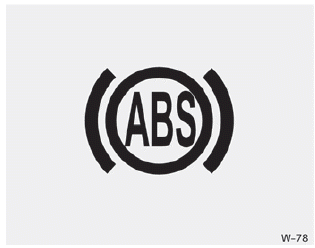
DANGER
- If the ABS warning light remains illuminated, there may be a problem with the ABS. In this case, normal braking still works, but the ABS will not function.
- The ABS warning light illuminates for about 3 seconds after the ignition is switched on. During this time the ABS performs a self-diagnosis. If everything is normal, the light turns off. If the warning light does not turn off, there may be a malfunction in the ABS. In this case, have the system checked at a qualified workshop. Kia recommends visiting a Kia dealer/service partner.
DANGER
- When driving on a surface with low traction (e.g. icy roads) for a long time, the ABS may be activated continuously and the warning light may illuminate. In this case, stop your vehicle in a safe place and turn off the engine.
- Restart the engine. When the ABS warning light turns off, the ABS system is functioning correctly. Otherwise, there may be a problem with the ABS. In this case, have the system inspected at a qualified workshop. Kia recommends visiting a Kia dealer/service partner.
NOTICE
If your vehicle's battery is discharged and must be started using jumper cables, the engine may run less smoothly than usual and the ABS warning light may illuminate at the same time. This is the result of too low a battery voltage. This does not mean that the ABS will not function properly.
- Do not pump the brakes repeatedly!
- Charge the battery before driving.
Test yourself
A quick Kia Stonic quiz: every answer comes with an explanation and a link to the manual page.