Climate Control System
General Safety Information and Precautions
PRECAUTIONS
HANDLING REFRIGERANT
R-134a is a highly volatile refrigerant. A drop on the skin may cause partial frostbite. Always wear protective gloves when handling refrigerant.
As a rule, always wear protective gloves and goggles. Hand and eye protection must be used. If refrigerant gets into the eyes, immediately flush with plenty of clean water.
R-134a container is under high pressure. Never leave it in heat and make sure the storage temperature is below 52 °C. False.
An electronic leak detector must be used to check the system for leaks. Also note that when R-134a burns, it releases highly toxic phosgene gas.
Use only the lubricant recommended for R-134a systems. Use of lubricants other than those recommended may cause system failure.
Compressor oil is very hygroscopic, therefore observe the following precautions:
Refrigerant circuit components are sealed immediately after removal to prevent moisture ingress.
Remove the caps from refrigerant circuit components during installation only immediately before connecting the corresponding component.
Connect refrigerant lines and hoses quickly and without interruption to prevent moisture from entering the system.
Use only approved lubricant from sealed containers.
In the event of accidental refrigerant leakage from the system, ventilate the work area thoroughly before continuing work.
PRECAUTIONS WHEN REPLACING AIR CONDITIONING COMPONENTS
Never loosen or open connections before the system has been evacuated.
Cover open component connections immediately with caps or plugs to prevent moisture and foreign objects from entering.
Remove caps or plugs only immediately before installing the corresponding component.
Always use new O-rings when connecting components. Apply compressor oil to the fitting and the seal before installation.
FOR INSTALLATION OF FASTENERS
FLANGE WITH GUIDE PIN
Check the new O-ring (use only the specified one) for damage and replace if necessary. Lubricate with compressor oil. Tighten the nut to the specified torque.
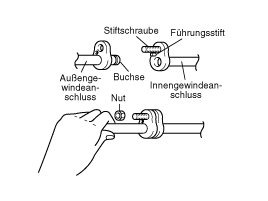
HANDLING OF PIPES AND CONNECTIONS
Internal components of the refrigeration system remain chemically stable as long as only refrigerants and lubricants such as those specified are used, without moisture and foreign matter entering. Penetrating foreign matter (dust), moisture and air can affect chemical stability and cause malfunctions and serious damage.
PRECAUTIONS TO BE OBSERVED
Make all necessary preparations before opening the refrigerant system so that the system is open only for as long as absolutely necessary.
Immediately close lines and connections with caps or plugs to prevent foreign objects and moisture from entering.
All lines and components kept in stock must remain tightly closed until use.
Do not bend preformed lines to make them fit. Use the appropriate line.
All special tools (including gauges and accessories) must be kept clean and dry.
Precautions (R-1234yf)
HANDLING REFRIGERANT
R-1234yf refrigerant is highly volatile. A drop on the skin may cause local frostbite. Always wear gloves when handling refrigerant.
As a rule, always wear protective gloves and goggles. Hand and eye protection must be used. If refrigerant gets into the eyes, immediately flush with plenty of clean water.
The R-1234yf container is under high pressure. Never leave it in heat, and make sure the storage temperature is below 52 °C.
An electronic leak detector is often used to check the system for refrigerant leaks. Note that when R-1234yf contacts an open flame, it produces phosgene, a highly toxic gas.
Use only the recommended lubricant for R-1234yf systems. Lubricants other than the recommended type may cause system failure.
Compressor oil is very hygroscopic, therefore observe the following precautions:
Refrigerant circuit components are sealed immediately after removal to prevent moisture ingress.
Remove the caps from refrigerant circuit components during installation only immediately before connecting the corresponding component.
Connect refrigerant lines and hoses quickly and without interruption to prevent moisture from entering the system.
Use only approved lubricant from sealed containers.
In the event of accidental refrigerant leakage from the system, ventilate the work area thoroughly before continuing work.
| 8th. | Before servicing or disconnecting refrigerant connections, remove all dirt. Remove grease and foreign matter from the connections. |
Description and Operation
REFRIGERANT CIRCULATION
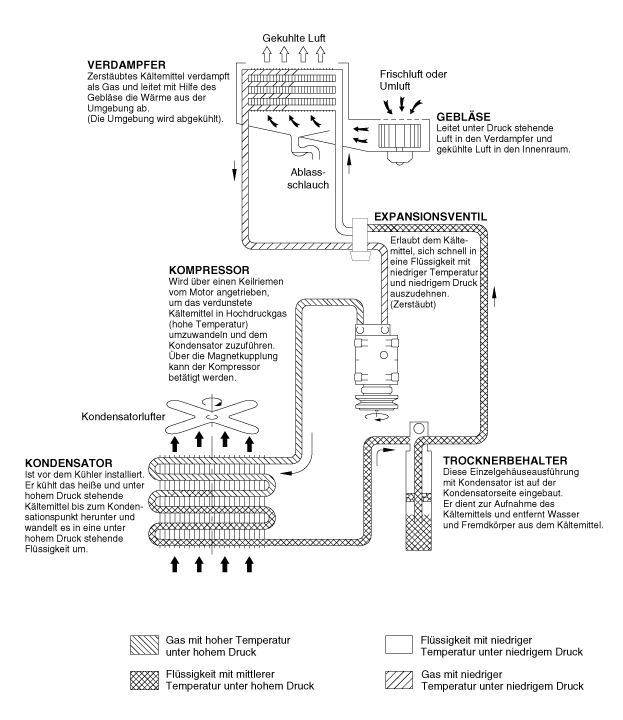
repair procedures
Check Refrigerant Specifications
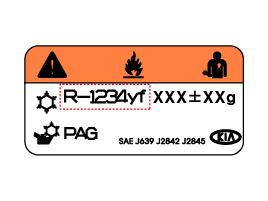
Read the refrigerant specification label located in the engine compartment.
R-134a R-1234yf Examples 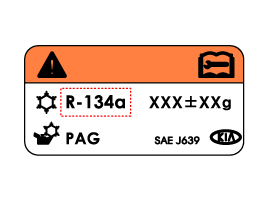
If the refrigerant specification label is not visible, check the diameter of the refrigerant service port.
R-134a R-1234yf High-pressure side 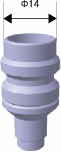
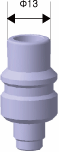
Low-pressure side 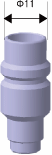
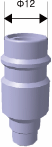
※ The diameter of the high/low-pressure side service port varies depending on the refrigerant specification.
BASIC REFRIGERANT HANDLING INSTRUCTIONS
REFRIGERANT DISCHARGE
To discharge R-134a refrigerant, use only equipment that complies with applicable standards and legal regulations.
In case of accidental refrigerant leakage, clean the work area before continuing. Ventilate the area thoroughly.
Refer to additional safety instructions and information from refrigerant and compressor oil manufacturers regarding possible health risks.
Connect R-134a/R-1234yf refrigerant.
Connect the recovery/recycling/charging station (A) to the high-pressure port (B) and the low-pressure port (C) according to the manufacturer's instructions.
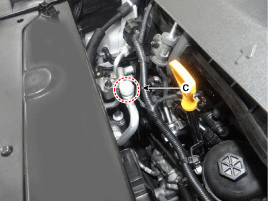
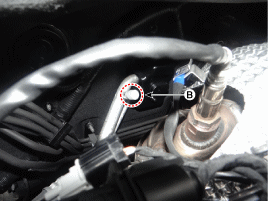
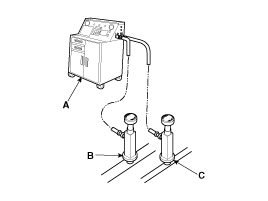
After discharging the refrigerant, measure the amount of oil drained. Make sure the same amount of oil is added before charging the system.
EVACUATING THE REFRIGERANT SYSTEM
To discharge R-134a refrigerant, use only equipment that complies with applicable standards and legal regulations.
In case of accidental refrigerant leakage, clean the work area before continuing. Ventilate the area thoroughly.
Refer to additional safety instructions and information from refrigerant and compressor oil manufacturers regarding possible health risks.
When the A/C system is exposed to ambient air, i.e., during installation or repair, it must be evacuated using an R-134a recovery/recycling/charging station. (If the system has been open to ambient air for several days, the receiver-drier must be replaced and the system must be evacuated for several hours.)
Used to discharge R-134a
Connect the recovery/recycling/charging station (A) to the high-pressure port (B) and the low-pressure port (C) according to the manufacturer's instructions.
If the vacuum does not drop below 93.3 kPa (700 mmHg), there may be a leak in the system. Partially charge the system and check for leaks (refer to Refrigerant Leak Test).
Disconnect the low-pressure valve from the low-pressure port.
CHARGING THE SYSTEM
To discharge R-134a refrigerant, use only equipment that complies with applicable standards and legal regulations.
In case of accidental refrigerant leakage, clean the work area before continuing. Ventilate the area thoroughly.
Refer to additional safety instructions and information from refrigerant and compressor oil manufacturers regarding possible health risks.
Used to discharge R-134a
Connect the recovery/recycling/charging unit (A) to the high-pressure port (B) as shown in the illustration, according to the manufacturer's instructions.
Charge the A/C system with exactly the same amount of new refrigerant as was removed during recovery. Use only the specified refrigerant oil. Charge the system with 450 ± 25 g (15.7 ± 0.88 oz) of R-134a refrigerant. Do not overfill the system, otherwise the compressor may be damaged.
REFRIGERANT LEAK TEST
Always perform a leak test using an electronic leak detector when a leak is suspected or when service work has been performed that involved removing, loosening or connecting components.
If a leak is detected, proceed as follows:
Check the tightening torque of the connection and tighten if necessary. Check for gas leaks using the leak detector (A):
If the leak persists after tightening the pipe connection, recover the refrigerant, disconnect the pipe connection and check the sealing surfaces for damage. Replace the affected components, even if the damage is minor.
Check the compressor oil and add if necessary.
Charge the A/C system again and recheck with the electronic leak detector. If no more leaks are detected, evacuate and charge the A/C system.
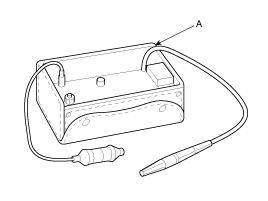
Components and Components Location
COMPONENT LOCATION OVERVIEW
Engine Compartment
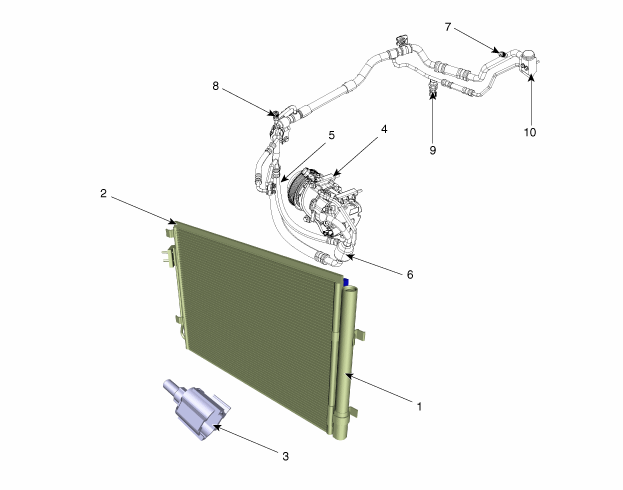
| 1. Receiver-drier 2. Condenser 3. Ambient temperature sensor 4. Compressor 5. Drain hose |
6. Suction and liquid hose 7. Service valve (low pressure) 8. Service valve (high pressure) 9. A/C pressure sensor (APT) 10. Expansion valve |
INTERIOR
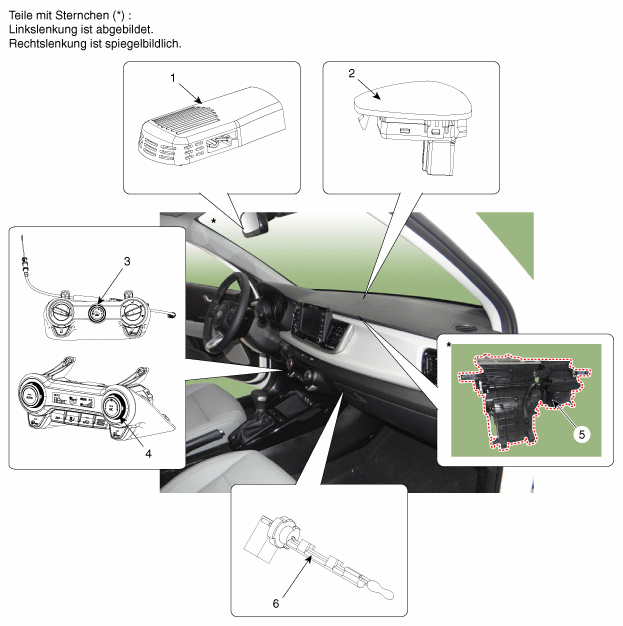
| 1. Automatic anti-fog sensor 2. Photo sensor 3. Heater and A/C controller (MANUAL) |
4. Heater and A/C control module (FATC) 5. Heater and blower unit 6. Evaporator temperature sensor |
Test yourself
A quick Kia Stonic quiz: every answer comes with an explanation and a link to the manual page.