Exhaust System Service
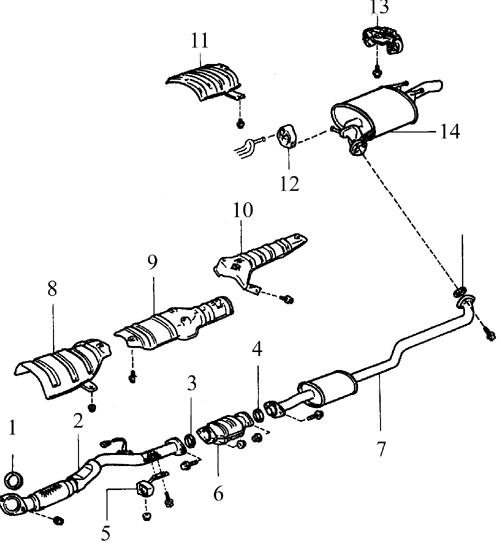
Exhaust System Components
1, 3, 4. Gasket
2. Front pipe
5. Bracket
6. Catalytic converter
7. Center pipe
8, 9, 10, 11. Heat shield
12. Ring
13. Bracket
14. Tail pipe
* Inspect and repair the exhaust system only after the components have completely cooled.
The exhaust system consists of the exhaust manifold, catalytic converter, mufflers (center and rear), connecting pipes and their mounting parts (brackets, clamps, insulators). The exhaust system is attached to the body through brackets and rubber mounts. If any component of the system fails, engine operation is accompanied by increased noise.
To keep the exhaust system in good condition, periodically check the condition of its components. Check for separated seams, burn-through and corrosion holes, and other defects that allow exhaust gases to enter the passenger compartment. Failed components are not repairable and must be replaced.
If components cannot be removed because they are seized by corrosion, cut them off. This is usually done in a workshop with a gas torch. However, if you want to save on these costs and do not have gas welding equipment, the pipes can be cut with a hacksaw. If compressed air is available, pneumatic shears can be used. Wear eye protection against metal chips and gloves when performing this work.
When repairing the exhaust system, observe the following rules:
– remove exhaust system components in order, starting from the tail pipe and ending with the front pipe;
– to make it easier to loosen nuts and bolts, apply penetrating fluid to them;
– when replacing pipes and mufflers, always replace the gaskets;
– apply thread locking compound to all threads during assembly;
– leave a gap between the vehicle underbody and the exhaust pipes to prevent overheating of the floor and damage to the anti-corrosion coating and floor mat.
Pay special attention to the installation of the catalytic converter and the heat shield during assembly.
* The catalytic converter operates at very high temperature and requires a long time to cool. Wait until the converter has completely cooled before removing it. Otherwise, serious burns may result.
Test yourself
A quick Toyota Corolla quiz: every answer comes with an explanation and a link to the manual page.