Automatic Transmission (AT)
The Audi 80 automatic transmission is controlled electronically/hydraulically. Along with four forward gears, this transmission also has two shift programs. The driver can choose whether to drive economically ("Sport" button not pressed, the AT upshifts as early as possible in the economy program) or to use the engine's power as fully as possible ("Sport" button pressed, in certain gear ranges the AT upshifts only at higher engine speeds).
General operating principle
The core of the AT consists of so-called planetary gear sets. Each consists of a sun gear around which three planet gears revolve. A ring gear with internal teeth is fitted over all of this from above. Such units are paired in one gear train and form a small two-speed gearbox of their own. The ingenious aspect of these gearboxes is the way they shift.
The gear ratio is changed only by holding or releasing elements of the planetary gear sets. In this way, shifting takes place without interruption of drive force. Holding and releasing are carried out by hydraulically controlled multi-plate clutches and multi-plate brakes. To obtain a multi-speed gearbox, three planetary gear sets are connected one after another. This gives a four-speed transmission with reverse. Coordination of the gear train is ensured by the hydraulic control of the transmission.
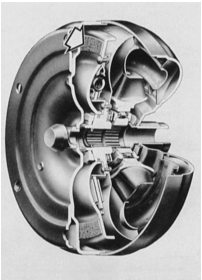
Torque converter
The torque converter cutaway clearly shows the impeller blades and the stator. The arrow points to the friction lining of the converter lock-up clutch, which connects the impeller to the engine and—except under cold ATF operating conditions—from higher gears onward locks up to a direct mechanical connection to prevent slip.
Engine torque is transmitted to the gearbox by means of fluid. The engine drives the impeller in the torque converter. The rotating converter fluid can in turn drive the turbine wheel, which is connected to the gearbox through the stator located between both wheels.
There is always a difference in speed between the impeller, rotating at engine speed, and the turbine wheel at the gearbox input. When starting from rest this difference is greatest; as speed increases, the speeds of the impeller and turbine become increasingly equal. However, in a conventional automatic transmission a certain "slip" still remains. In our gearbox, the torque converter is locked up in third and fourth gear ranges, i.e. a rigid connection exists between the engine and the AT. In this way fuel is saved.
Test yourself
A quick Audi 80 quiz: every answer comes with an explanation and a link to the manual page.