Electronic AT Control
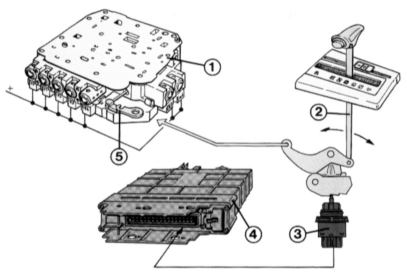
The diagram shows the connections between the AT shift valve body (1), the selector lever (2), the multifunction switch (3) and the electronic control unit (4). The manual valve (5) is actuated directly by the selector lever.
Input signals
The control unit processes numerous signals from various components; information is received from:
The AT selector lever with multifunction switch. The lever position determines the activation of the reverse lights, the starter lockout when in drive, and the control of the driving mode selection system.
The "Sport" button, which activates the sport shift program.
The throttle valve potentiometer, which signals the throttle valve position. This component, familiar from the injection system, is used to determine shift points.
The vehicle speed sensor in the AT, which determines vehicle speed, also for shift points. If this sensor fails, the control unit uses engine speed (from the Hall sensor) as a substitute signal.
The accelerator pedal kickdown switch on the cable-operated throttle; it signals when the accelerator pedal has been fully depressed. In this case, the upshift occurs later, and the AT downshifts two ranges if necessary.
The brake light switch, which releases the selector lever lock. The selector lever can be moved from position "P" or "N" into one of the driving ranges only with the brake pedal depressed.
ATF temperature sensor, which signals the fluid temperature in the automatic transmission. Significant heating of the ATF can be the result of a large difference in speed between the engine and the transmission. If the control module receives a "high temperature" signal, then
the automatic transmission shifts into a higher gear earlier in certain ranges. This reduces slip in the torque converter and lowers the ATF temperature, after which the vehicle returns to the normal driving program.
Shift Process Control
When the selector lever is moved to the "D" position, the pressurized ATF flows to the so-called shift valves in the valve body, which in turn hydraulically actuate the multi-plate clutches and multi-plate brakes. The Digimat control module regulates pressure by means of solenoid valves and thus determines the timing of upshifts and downshifts as well as the shift transitions. At the same time, communication is maintained with the fuel injection/ignition control module; during an upshift the ignition timing is retarded slightly so that the shift transition is smooth.
Commands from the control module are then sent to the selector lever lock solenoid, the starter lockout relay and reverse light relay, and the indicator light in the "Sport" button. If the Audi 80 is equipped with cruise control, the control module supplies power to it only when one of the forward driving ranges is engaged and the vehicle speed has first reached the limit of 30 km/h.
Self-Diagnosis
The automatic transmission control module can detect and store faults that occur. The diagnostic program monitors the input and output signals of virtually all sensors and components, as well as their electrical circuits. Faults that occur are stored in the long-term memory of the control module. During appropriate inspection at a workshop, the fault memory is read out using special equipment. It is not possible to check the fault memory at home. Even if you suspect a fault in the automatic transmission control, the fault memory can only be read at an Audi workshop.
Emergency Operation
If the control module detects a fault that significantly affects operation, or if the control module itself is faulty, it switches to "emergency operation" mode. Two programs are available for this:
As before the fault was detected, the transmission shifts automatically to higher or lower gears, but shift jerks become considerably more pronounced.
The transmission no longer shifts automatically up or down. In the "D", "3" and "2" selector positions, only third gear remains available. Only in the "1" and "R" positions is the selected range actually engaged.
In both cases, the vehicle must be taken to an Audi workshop without delay, where the fault memory will be read out first.
Test yourself
A quick Audi 80 quiz: every answer comes with an explanation and a link to the manual page.