Knock Control
Except 66 kW engines
Knock combustion, which occurs if the ignition timing has been advanced too far, damages the engine. The result is overheating, bearing damage and piston damage.
However, the engine produces maximum power when the ignition is set as early as possible, that is, when the engine operates at the knock limit. This knock limit depends on many factors (fuel quality, deposits on the combustion chamber walls, etc.), so it cannot be determined precisely. Therefore, a larger safety margin is normally required for ignition timing control. Knock control determines whether knock combustion occurs and adjusts the ignition timing accordingly.
Knock Control Operating Principle
Combustion in the cylinders is monitored by the knock sensor, which is located on the left side of the cylinder block on models with 4- and 5-cylinder engines. Models with 6-cylinder engines are equipped with two sensors, on the right and left at the top of the cylinder block. The knock sensor detects irregular vibrations in place of normal even vibrations during combustion in a cylinder. It transmits this information to the control unit.
The following occurs: when a signal of knock combustion at the last ignition is received, the next cylinders with normal combustion still receive the spark at the ignition timing previously calculated. However, the ignition timing of the cylinder in which knock was detected is retarded by approximately 3°. This occurs only for that single cylinder. All other cylinders continue to operate as before.
If knock combustion in the affected cylinder still persists, the ignition timing is retarded by a further 3° at the next working cycle. Adjustment can be carried out up to a maximum of 15° (calculated from the basic ignition timing).
If combustion in the affected cylinder is now normal, the ignition timing is advanced again in the direction of "early ignition" after some time. The adjustment is made in steps of 0.5°, followed by a pause of many working cycles before a further 0.5° correction is made in the direction of "early ignition".
This process continues until the originally planned ignition timing is reached or until the sensor again reports knock combustion.
Knock Sensor
It "listens" for knock inside the engine: the knock sensor (arrow) on the 4-cylinder 85 kW engine (left) and on the 5-cylinder engine is located on the left side of the engine. On models with a 6-cylinder engine (right), there are two knock sensors: one on the right and one on the left at the top, below the exhaust manifold. Important: the knock sensor mounting bolt must be tightened precisely to 20 N•m, otherwise the sensor will not function.
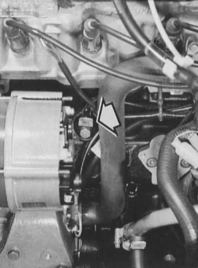
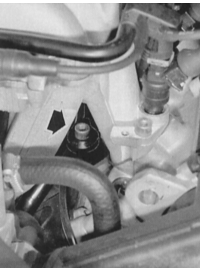
A piece of piezoceramic material, the same material used in lighters (which produce a spark), is inserted into this sensor. Mechanical forces (tension and compression) acting on the piezoceramic are converted by it into electrical voltage. Irregular vibrations caused by knock combustion are sufficient to activate the sensor. Important: the knock sensor tightening torque must be precisely 20 N•m.
Test yourself
A quick Audi 80 quiz: every answer comes with an explanation and a link to the manual page.