Thermostat
In simple terms, the thermostat determines whether or not coolant circulates. That is, it determines whether the coolant flows through the small circuit or the large circuit (see also the beginning of this section). The thermostat controls the coolant flow depending on its temperature. This is done by means of a wax-filled element and the valve plate attached to it.
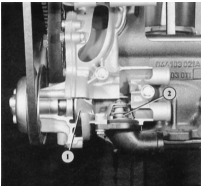
The illustration shows the water pump and thermostat housing in section so that you can see inside. The impeller (1) of the water pump is clearly visible. The thermostat (2) is located next to it.
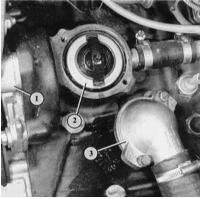
After removing the housing cover (3) on the left side of the engine, the thermostat (2) becomes accessible on the 5-cylinder engine. Item (1) shows the water pump.
As the coolant heats up, the wax melts, expands and opens the valve plate. As the coolant temperature rises, the thermostat opens increasingly to allow coolant from the radiator to flow. If the operating temperature drops, the spring in the thermostat presses the valve plate back into the "closed" ("zu") position, thereby blocking the flow from the radiator until the operating temperature is reached again.
Test yourself
A quick Audi 80 quiz: every answer comes with an explanation and a link to the manual page.