Cooling fan
The Audi 80 is equipped with an electrically driven fan that switches on only when required. This saves fuel.
For this reason, a temperature-sensitive switch is screwed into the radiator. If it senses that the coolant flowing past it after passing through the radiator is still hot, it switches on the fan via a relay in plug cavity 2. In the same way, it switches off the electric fan when the temperature at the lower part of the radiator has dropped to a specified value.
Two-stage cooling fan
Some versions of the Audi 80 are equipped with a two-stage fan. Under high engine load and correspondingly higher coolant temperature, the thermoswitch activates the higher fan speed. This is possible thanks to a two-stage thermoswitch, which closes a second current path to the fan through another relay located in plug cavity 11.
In certain equipment versions of the Audi 80, for example with a 4-cylinder engine and a factory-fitted towing hitch, or on vehicles with a heavy-duty cooling system, an additional fan is installed next to the cooling fan already mentioned. It is driven by the V-belt of the first fan.
On models with a 5-cylinder engine there is no space for a second cooling fan. Therefore, when a towing hitch is installed at the factory, this engine is fitted with a more powerful fan motor.
Models with a 6-cylinder engine are equipped with one fan in standard configuration, or with two independently driven fans in the special version.

The illustration shows the cooling fans of the 4-cylinder engine with a heavy-duty cooling system. It works as follows: the cooling fan (2) drives the second cooling fan (1) by means of a small V-belt.
On the 6-cylinder engine, a two-stage fan is used in place of this design. Vehicles with a heavy-duty cooling system, on the other hand, are equipped with two two-stage fans, each with its own drive.
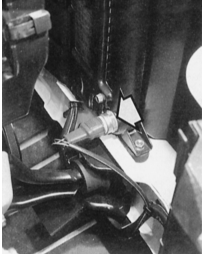
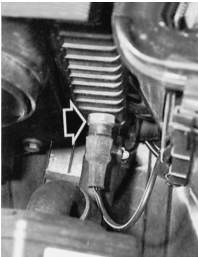
The cooling fan thermoswitch is installed at the bottom of the radiator. The illustrations show: left – 4-cylinder engine, right – 6-cylinder engine. Besides those shown, there are equipment variants in which the thermoswitch is installed on the left side of the radiator.
Cooling fan thermoswitch switching temperatures
| Fan version | Switch-on temperature | Switch-off temperature |
| Single-stage | 92 – 97°C | 84 – 91°C |
| Two-stage | ||
| first stage | 92 – 97°C | 84 – 91°C |
| second stage | 99 – 105°C | 91 – 98°C |
Electrical switching
Wiring diagrams can be found in the Electrical Diagrams section. The standard versions work as follows:
PROCEDURE
4-cylinder engine, 66 kW: the thermoswitch does not control the fan directly, but through a relay in plug cavity 2 of the central switch box. That is, it is part of the relay control circuit and determines when the relay contacts must close to switch current from terminal 30 (permanently live) to the fan.
The control circuit itself receives current from terminal X only when the ignition is switched on, so the relay contacts can close only with the ignition on.
4-cylinder engine, 85 kW, and 5-cylinder engine: these models have a two-stage fan with a specific double switching. The double thermoswitch controls the slower fan motor speed through a relay in plug cavity 11.
On these engines the switching is supplemented by the so-called after-run fan function. It works as follows: if hot air stagnates in the engine compartment after the engine is switched off, the cooling fan provides a flow of cool air. This prevents vapor lock in high-pressure fuel lines, which causes hot-start problems.
In this circuit, the thermoswitch on the cylinder head senses the temperature and switches on the fan through the after-run control unit of the cooling fan via relay plug cavity 3 after the engine is switched off.
6-cylinder engine: here we have one or two two-stage fans. The double thermoswitch (originally its part for the first stage) passes current through the relay in plug cavity 11 for the first fan speed. Reduced speed is achieved by installing an additional resistor that limits the power supply to the fan motor.
If the thermoswitch switches on the second fan speed, power is supplied through the relay in plug cavity 18, directly to the separate fan or to the two fan motors, bypassing the resistor plate.
Note: Due to the electrical connection via terminal X (see also the Body Electrical System chapter), the radiator cooling fan – whether single-speed or two-speed – cannot start operating with the ignition switched off.
The situation is different for models with the 4-cylinder engine rated 85 kW and with the 5-cylinder engine, due to the cooling fan run-on function after engine shutdown. Here the fan can start running even with the engine switched off. Therefore, be careful when working in the engine compartment!
Test yourself
A quick Audi 80 quiz: every answer comes with an explanation and a link to the manual page.