Car Telephone, Radio Reception, Car Radio
Car Telephone Mobile communication systems (radiotelephones, two-way radios, etc.) may cause interference with the normal operation of your vehicle if they are not specifically designed for it. BMW cannot monitor all products of this kind and therefore cannot accept responsibility for them. Before purchasing such systems, we recommend consulting a BMW service station.
To ensure the operational reliability of your vehicle, do not use radiotelephones and other portable radio transmitters whose antenna is located inside the passenger compartment or is not securely mounted outside the vehicle.
Remove the antenna before loading the vehicle onto rail car transport or before passing through automatic car washes.
Radio Reception
The quality of sound reception and reproduction by the car radio depends on the distance to the radio station, as well as the vehicle position during reception and the antenna orientation.
Despite the excellent interference suppression of the vehicle's systems, non-suppressible extraneous noise caused by external influences occurs during reception while driving. Its sources are high-voltage power lines, buildings or natural obstacles in the path of radio waves. Environmental factors such as solar radiation intensity, fog, rain or snowfall can also interfere with radio reception.
Car or portable telephones not recommended by BMW may also be sources of interference. This interference appears as a low-pitched humming from the loudspeakers.
Installation and handling of the radio are described in the enclosed operating instructions.
Car Radio
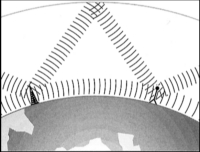
The medium wave, long wave and short wave bands provide a long reception range, since radio signals propagate not only as surface waves following the curvature of the Earth but also as sky waves reflected by the ionosphere.
The VHF (FM) band provides significantly better sound reproduction quality than any other waveband. However, the range of stations broadcasting in this band is limited due to the straight-line propagation of ultra-short waves.
Certain reception limitations are partially compensated by "smart" systems.
The RDS (Radio Data System) automatically selects the frequency with the best reception quality if a radio station broadcasts on several frequencies.
The antenna diversity method means that several antennas for receiving VHF signals are integrated into the rear window. Thus, the vehicle has three antennas independent of each other. The built-in processor automatically selects the antenna that provides the best VHF reception. Switching between antennas takes place within milliseconds and is completely imperceptible to the occupants.
Test yourself
A quick BMW 1 quiz: every answer comes with an explanation and a link to the manual page.