Safety Systems
Seat Belts
Fasten the seat belts before every trip.
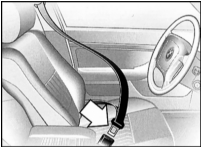
Seat Belts
Fastening: when fastening, the buckle latch must lock with an audible click.
Unfastening: press the red button to release the tongue from the buckle and hold the belt webbing, guiding it into the retractor.
Adjustment of the upper anchorage point for the occupant's height takes place automatically during longitudinal seat adjustment.
The seat belt locks when:
- the webbing is pulled out sharply
- the vehicle brakes or accelerates sharply
- the vehicle goes around corners
- the vehicle leans heavily to one side
Seat belt pretensioner
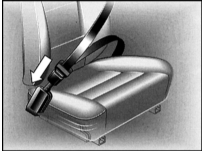
Seat Belt Pretensioner
The belt tensioner ensures a much better fit of the belt against the occupant's body during a collision and holds the occupant securely in the seat. Within a fraction of a second, the gas pressure pulls the buckle back and simultaneously tightens the diagonal and lap belts. This reliably prevents the occupant from sliding under the lap belt.
For your own safety, observe the following instructions for using the belt, otherwise it will not be able to fully perform its protective function. Inform all of your passengers about the need to observe the rules for using seat belts.
Only one person may ever use each seat belt. While the vehicle is in motion, infants and small children must not be held on the laps of adult passengers.
The belt webbing must be pulled taut and lie flat against the chest and hips without twisting. There must be no hard or brittle objects in clothing pockets between the belt and the body. The belt must not cross the neck. Do not allow the belt to be pinched or rubbed against sharp edges.
The belt should fit as closely to the body as possible; therefore, clothing must not be bulky. Tighten the belt frequently at the shoulder area. Otherwise, in frontal collisions a loosely fitting lap belt may slide up over the hips and injure the lower abdomen. Due to the increased gap between the belt and the body, the restraining effect of the belt is delayed.
Pregnant women must always use seat belts, making sure in particular that the lap portion passes under the hips and does not press on the abdomen.
Do not make any modifications to the seat belt system.
Safe Transportation of Children*
Children under 12 years of age and under 150 cm (4 ft 11 in) in height must be transported in approved child restraint systems.
Infants up to 9 months old may be transported in infant carriers installed on the rear seat facing rearward and secured with the standard seat belts.
For each age group, your BMW service center will offer the appropriate child restraint systems.
Do not install child restraint systems on the front passenger seat, otherwise injuries may occur if the front airbag deploys.
Do not modify child restraint systems, otherwise they will not be able to fully perform their protective function.
Integrated Child Seats*
These two child seats, integrated into the rear seat and conforming to legal requirements based on EU Directive R-44, are intended for children from 3 to 12 years old (15 to 38 kg / 33 to 84 lb).
For children from 9 months to 3.5 years old (9 to 18 kg / 20 to 40 lb), these seats must be used in combination with a special back support and impact protection table, which are available from your BMW service center.
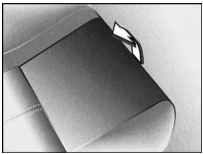
Rear Seat Extension
Grasp the front of the rear seat cushion and pull it up and slightly rearward, as shown by the arrow.
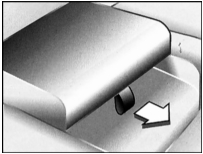
Rear Seat Lowering
Grasping the loop, pull forward and down, as shown by the arrow.
Observe the seat belt instructions above, otherwise they will not be able to perform their protective function.
Supplemental Restraint System (SRS) Airbags
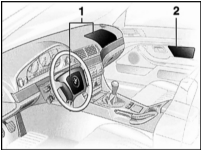
1 — front airbags for driver and front passenger
2 — side airbags*
Protective Function
The front airbags protect the driver and front passenger in a frontal collision when the protection provided by the seat belts alone is insufficient. Side airbags provide protection in side impacts.
In the event of an accident, only the airbag on the side where the impact occurs will deploy.

The illustration shows the impact directions to which the airbags respond. Side protection is provided only on vehicles equipped with side airbags.
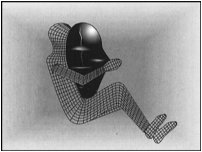
Inertia sensors constantly monitor the acceleration forces acting on the vehicle. If, as a result of a collision, the driver and passenger are subjected to acceleration forces at which the seat belts alone can no longer provide sufficient protection, the inflators of the driver and front passenger airbags are triggered simultaneously. However, the front passenger airbag is activated only if the seat sensor detects that a person is actually seated in the seat.
Inertia sensors constantly monitor the acceleration forces acting on the vehicle. If, as a result of a collision, the driver and passenger are subjected to acceleration forces at which the seat belts alone can no longer provide sufficient protection, the inflators of the driver and front passenger airbags are triggered simultaneously. However, the front passenger airbag is activated only if the seat sensor detects that a person is actually seated in the seat.
In the event of a side collision, the side airbag on the side where the impact occurs is triggered if necessary.
The airbags located beneath the trim covers of the steering wheel, instrument panel, and front door side trim panels unfold, inflating with gas within a few milliseconds. In doing so, they tear the trim covers at predetermined locations.
The rapid deployment required for proper airbag operation is accompanied by a popping sound and inflation noise, which, however, are not noticed during an accident. The gas used to inflate the airbags is not hazardous and dissipates after a short time together with the smoke that forms.
The entire process takes place within one twentieth of a second.
Airbag Warning Lamp

The indicator lamp on the instrument cluster signals that the system is ready for operation as soon as the ignition key is turned to position 1.
System is ready for operation:
The indicator lamp lights up for a short time, then goes out.
System is faulty:
The indicator lamp does not light up.
The indicator lamp lights up briefly, goes out, and then lights up again.
If the system is faulty, there is a risk that it will not deploy in a collision with an obstacle, even if the impact is severe enough.
Have the system checked immediately at a BMW service center.
The airbag indicator lamp also lights up when the belt tensioner deploys.
For your safety, observe the airbag instructions below; otherwise, the airbags cannot fully perform their protective function. Inform all of your passengers of the airbag instructions.
Airbags do not replace the need to wear a seat belt, since airbags are only one of the safety devices. In minor accidents, vehicle rollover, and rear impacts, and in side impacts if the vehicle is not equipped with side airbags, only the seat belt protects you.
Sit on the seat in the position most comfortable for you, but as far as possible from the steering wheel, instrument panel, or door.
Always hold the steering wheel by the rim. Failure to do so may result in injury to the hands or forearms. There must be no objects between the airbag and the person it protects. The front passenger airbag cover must not be used as a shelf for small items.
Do not attach, cover, or modify in any way the energy-absorbing steering wheel, instrument panel, or door trim covers.
Do not install child restraint systems on the front passenger seat. Children under 12 years of age must be transported only on the rear seat.
Even when all instructions are followed, under certain circumstances injuries to the face caused by airbag deployment cannot be excluded. For sensitive passengers, the report and noise during airbag inflation may cause a temporary reduction in hearing.
Locking children in the vehicle
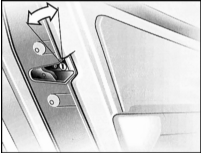
Insert the key into the slot in the rear door and turn it outward.
It will then be impossible to open the door from the inside of the vehicle.
Test yourself
A quick BMW 1 quiz: every answer comes with an explanation and a link to the manual page.