Exhaust System - General Information
Service the exhaust system only after its components have fully cooled. Make sure the vehicle is securely supported in the raised position.
All vehicles covered in this Manual are equipped with an exhaust system with flexible sections that are extremely sensitive to sharp bends. Avoid excessive bending of the pipes when inspecting components.
The exhaust system of all models covered in this Manual consists of the exhaust manifold(s), front pipe, catalytic converter, muffler, connecting pipe sections, clamps, as well as support brackets and rubber hangers by which the exhaust assembly is suspended from the underbody. Incorrect installation of system components and sections increases noise and vibration transmitted to the vehicle body.
Regularly inspect the entire system for corrosion, deformation and mechanical damage. Check that the fasteners are tight. Loss of sealing at components and their joints may allow exhaust gases to enter the passenger compartment. Defective components and sections must be replaced.
If the system is heavily corroded, a gas cutting torch may be required to separate its sections (alternatively, a hacksaw or pneumatic chisel can be used - be sure to wear protective goggles and gloves).
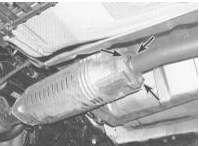
Exhaust system repair must be performed in the following order:
a) When removing components, work along the system from the exhaust pipe toward the engine;
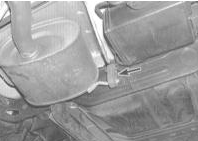
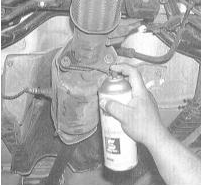
b) Lubricate the fasteners to be removed with penetrating oil in advance;
c) Prepare the required replacement gaskets, hangers, clamps and fasteners in advance;
d) Before installation, apply anti-seize compound to the threads of the fasteners;
e) When installing components, make sure there is sufficient clearance between the system sections and nearby suspension/body parts.
Pay special attention to the correct installation and secure mounting of the catalytic converter heat shield.
Test yourself
A quick Honda Accord quiz: every answer comes with an explanation and a link to the manual page.