Intake Air Temperature (IAT) Sensor "OBD"
The intake air temperature sensor is a thermistor whose resistance changes with temperature. The ECM uses the sensor signal to correct the pulse width supplied to the injectors, which changes the amount of fuel supplied to the engine cylinders, and also changes ignition timing.
Sensor Inspection
PROCEDURE
1. Measure the voltage between terminals 1 and 3 of the sensor connector.
Temperature Output voltage
0 °C 3.3–3.7 V
20 °C 2.4–2.8 V
40 °C 1.6–2.0 V
80 °C 0.5–0.9 V
2. If the sensor output voltage differs from the specified value, replace the sensor.
Manifold Absolute Pressure (MAP) Sensor, except "OBD"
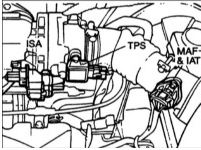
The manifold absolute pressure sensor is a sensitive variable resistor. It measures the pressure in the intake manifold, which changes depending on engine operating conditions, and converts it into voltage. The sensor is also used to measure atmospheric pressure when starting the engine and to ensure engine operation at different altitudes above sea level. Based on information from the sensor, the ECM controls the amount of fuel supplied to the engine and also changes ignition timing.
Inspection
PROCEDURE
1. Measure the voltage between terminals 1 and 4 of the sensor connector.
Output voltage with ignition ON and engine not running: 4–5 V
Output voltage at idle speed: 0.5–2.0 V
2. If the sensor output voltage differs from the specified value, replace the sensor.
Intake Air Temperature (IAT) Sensor
The intake air temperature sensor is a thermistor whose resistance changes with temperature. The ECM uses the sensor signal to correct the pulse width supplied to the injectors, which changes the amount of fuel supplied to the engine cylinders, and also changes ignition timing.
Inspection
PROCEDURE
1. Measure the resistance between terminals 1 and 2 of the sensor connector.
Temperature Resistance
0 °C 4.5–7.5 Ω
20 °C 2.0–3.0 Ω
40 °C 0.7–1.6 Ω
80 °C 0.2–0.4 Ω
2. If the resistance of the sensor differs from the specified value, replace the sensor.
Engine Coolant Temperature (ECT) Sensor

The engine coolant temperature sensor monitors the engine coolant temperature. Based on the sensor signal, the ECM calculates the injector pulse width, which changes the amount of fuel supplied to the engine cylinders, and also changes the ignition timing advance angle.
When the engine is cold, the ECM operates in open loop, which supplies a richer air-fuel mixture to the engine cylinders and increases the idle speed. This continues until the engine reaches normal operating temperature.
Removal
PROCEDURE
1. Remove the sensor from the engine.
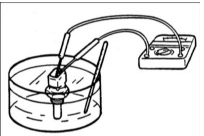
2. Heat a container of water with the sensor immersed in it, and check the sensor resistance.
Temperature Resistance
–30 °C 22.22–31.78 kΩ
–10 °C 8.16–10.74 kΩ
0 °C 5.18–6.60 kΩ
20 °C 2.27–2.73 kΩ
60 °C 1.059–1.281 kΩ
40 °C 0.538–0.650 kΩ
80 °C 0.298–0.322 kΩ
90 °C 0.219–0.243 kΩ
3. If the resistance of the sensor differs from the specified value, replace the sensor.
Installation
PROCEDURE
1. Apply LOCTITE 962T sealant to the sensor threads.
2. Screw the sensor into the cylinder block and tighten it to the specified torque.
Torque: 15–20 N·m
3. Connect the electrical connector to the sensor.
Test yourself
A quick Hyundai Accent quiz: every answer comes with an explanation and a link to the manual page.