Condenser Fan
Description and Operation
Description
[A/C Type]
The cooling fan operates in 2 stages (HIGH/LOW). The Engine Control Module (ECM) controls the radiator fan based on coolant temperature, vehicle speed and A/C operation.
[Non-A/C Type]
The cooling fan operates in 1 stage (HIGH). The Engine Control Module (ECM) controls the radiator fan based on coolant temperature, vehicle speed and A/C operation.
Specifications
Specifications
| Position | SPECIFICATIONS |
| Fan design | Puller |
| Blower Speed Control | PWM |
| Air Flow (m³/h) | 2050 - 8% min. |
| Fan Speed (rpm) | 2150 - 8% min. |
| Current (A) | 23.3 +10% max. |
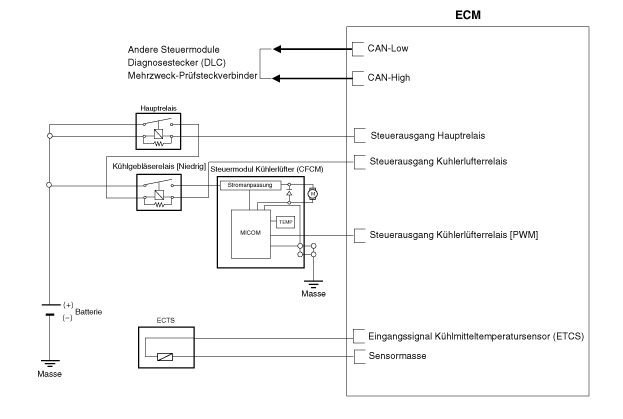
Schematic diagrams
Circuit diagram
repair procedures
radiator fan
Remove the condenser fan.
(Refer to Cooling System - "Radiator")
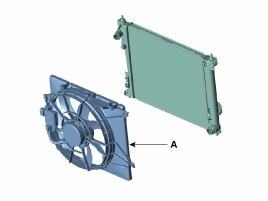
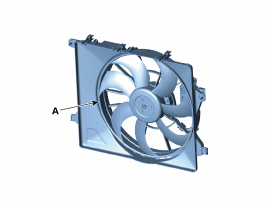
Remove the fan (A) from the radiator.
Tightening torque: 4.9 - 7.9 N·m
Installation is the reverse of removal.
Cooling Fan Control (PWM)
Remove the air duct.
(See Intake and Exhaust System - Air Cleaner)
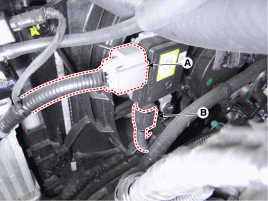
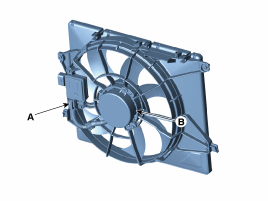
Disconnect the cooling fan control connector (A) and the cooling fan connector (B).
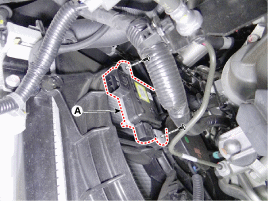
Remove the cooling fan control unit (A).
Tightening torque: 2.8 - 3.3 N·m
Installation is the reverse of removal.
DISASSEMBLY
Remove the radiator fan (A) from the radiator fan assembly.
Tightening torque: 2.8 - 3.3 N·m
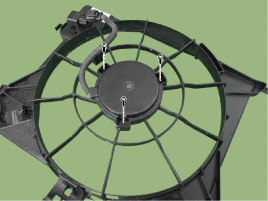
Disconnect the cooling fan motor connector (A), then remove the shroud cover (B).
Tightening torque: 2.8 - 3.3 N·m
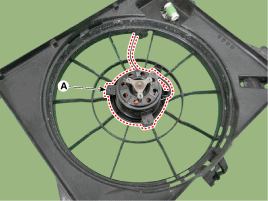
Remove the fan motor (A) from the radiator fan shroud.
Tightening torque: 4.9 - 8.3 N·m
Install in the reverse order of removal and observe the installation notes.
TEST
Fan motor
Disconnect the fan motor connector from the resistor.
Connect battery voltage to the positive (+) terminal and ground the negative (-) terminal.
Make sure the cooling fan motor operates correctly.
Test yourself
A quick Kia Stonic quiz: every answer comes with an explanation and a link to the manual page.