Fuel Delivery System
Components and Component Location
Component Location
Fuel Tank and Filler Neck Assembly
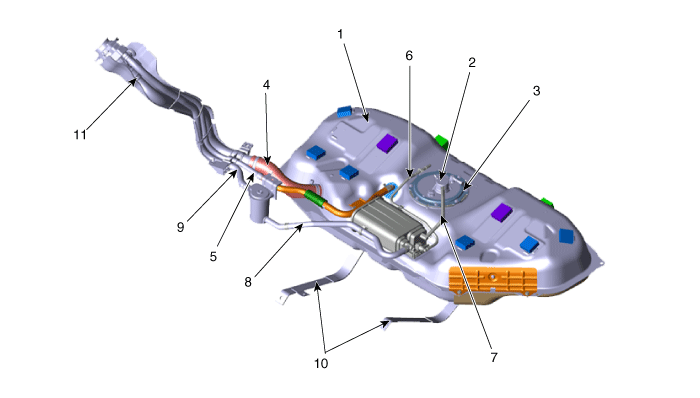
| 1. Fuel tank 2. Fuel pump 3. Fuel pump plate cover 4. Fuel hose 5. Balance tube 6. Vapor tube (canister → intake manifold) |
7. Vapor hose (canister → fuel tank) 8. Vapor hose (canister → air cleaner) 9. Vapor hose (air cleaner → atmosphere) 10. Fuel tank band 11. Filler neck assembly |
Fuel pump
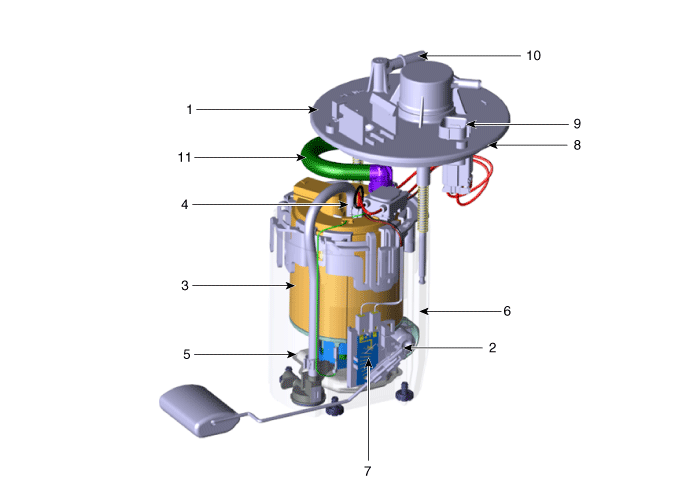
| 1. Head Assembly 2. Fuel Pressure Regulator 3. Fuel Filter 4. Fuel Pump Motor 5. Pre-filter 6. Reservoir Cup |
7. Fuel level sensor 8. Fuel pump plate seal 9. Fuel pump motor and fuel level sensor connector 10. Fuel supply port 11. Fuel supply tube |
Fuel Pressure Inspection (Low-Pressure System)
Fuel Pressure Inspection (Low-Pressure System)
Release the residual pressure in the fuel line.
(Refer to "Fuel Line Residual Pressure Release" in this group).
Install the Special Service Tool (SST).
Disconnect the low pressure fuel feed hose from the inlet of the high pressure fuel pump.
Install the special service tool for measuring fuel pressure between the low pressure fuel supply tube and the low pressure inlet of the high pressure fuel pump (see figure below).
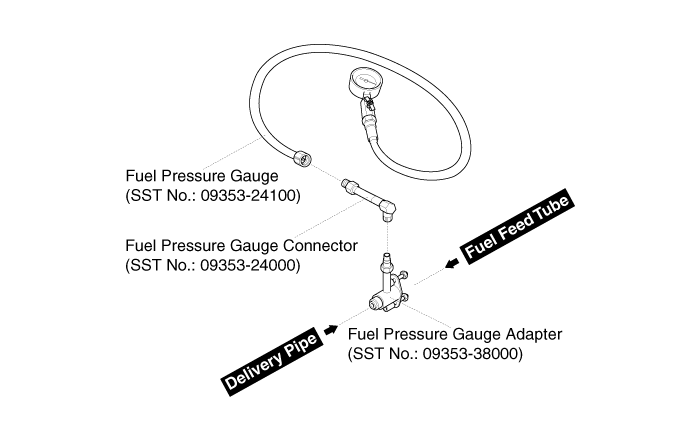
With the ignition ON, inspect for fuel leaks at the connections between the low-pressure fuel feed pipe, the high-pressure fuel pump low-pressure inlet, and the SST components.
Measure the fuel pressure.
Start the engine and measure fuel pressure at idle.
Fuel pressure:
330–370 kPa (3.36–3.77 kgf/cm², 47.86–53.66 psi)
Fuel
PressureCause Related Part Too low Clogged fuel filter Fuel filter Fuel leakage Fuel Pressure Regulator Too high Fuel pressure regulator valve stuck Fuel Pressure Regulator Stop the engine, and then check the fuel pressure gauge for pressure change.
Specification: The fuel pressure gauge reading should be maintained for approximately 5 minutes after the engine is stopped.
Fuel Pressure
(After Engine Stop)Cause Related
PartFuel pressure drops slowly Injector leakage Injector Fuel pressure drops immediately Fuel pump check valve stuck open Fuel pump Turn the ignition off.
Release the residual pressure in the fuel line (refer to "Fuel Line Residual Pressure Release").
End of test
Remove the Special Service Tool (SST) from the low pressure fuel feed hose and the low pressure inlet of the high pressure fuel pump.
Connect the low-pressure fuel feed tube and the hose to the low-pressure inlet of the high-pressure fuel pump.
Release Residual Fuel Line Pressure
Release Fuel Line Residual Pressure
Turn the ignition switch OFF and disconnect the negative (-) battery cable.
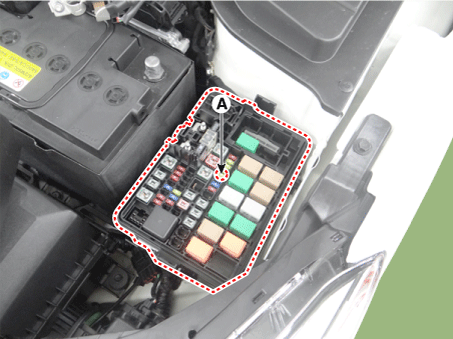
Remove the fuel pump fuse (A).
Connect the negative (-) battery terminal.
Start the engine and let it idle.
Turn the ignition switch OFF after the engine stops on its own.
Disconnect the negative (-) battery cable, and then install the fuel pump fuse (A).
Connect the negative (-) battery terminal.
Clear the diagnostic trouble code (DTC) related to the fuel pump fuse with the KDS/GDS.
Test yourself
A quick Kia Rio YB quiz: every answer comes with an explanation and a link to the manual page.