Mechanical System Tests
MECHANICAL SYSTEM TESTS
SHIFT LAG TEST
NOTICE:
- Perform this test only after verifying and confirming that the engine is operating normally.
- Perform this test when the CVT fluid temperature is between 50 and 100 °C.
- Perform this test with the A/C switched off.
- Perform this test with the AUTO function (function associated with gear shifting) of the electronic parking brake system set to OFF.
HINT:
When the shift lever is moved while the engine is idling, a certain delay occurs before the shock is felt. This test checks the condition of the clutches and brakes.
(a) Connect the Techstream to the DLC3.
(b) Start the engine.
(c) Turn on the Techstream.
(d) Select the following menus: Powertrain / Engine and ECT / Data List.
Powertrain > Engine and ECT > Data ListA/T Oil Temperature 1
(e) Drive the vehicle until the CVT fluid temperature reaches 50 to 100 °C.
(f) Let the engine idle with the air conditioning turned off.
(g) Apply the parking brake and firmly depress the brake pedal.
(h) Check the lag when shifting into D.
(1) Place the shift lever in N and wait 1 minute.
(2) Place the shift lever in D and measure the time elapsed before the shock.
(3) Repeat the above 2 steps 3 times and calculate the average lag time for the 3 tests.
Standard value:
The lag when shifting into D is less than 1.5 seconds.
(i) Check the lag when shifting into R.
(1) Place the shift lever in N and wait 1 minute.
(2) Place the shift lever in R and measure the time elapsed before the shock.
(3) Repeat the above 2 steps 3 times and calculate the average lag time for the 3 tests.
Standard value:
The lag when shifting into R is less than 1.5 seconds.
CAUTION:
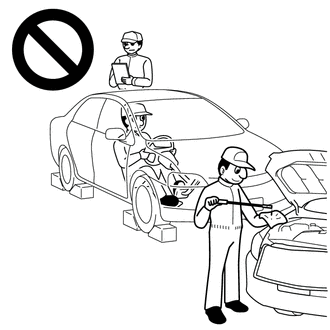
- Do not perform a stall test when anyone or any objects are near the vehicle.
- The vehicle may move suddenly, which could result in a serious accident.
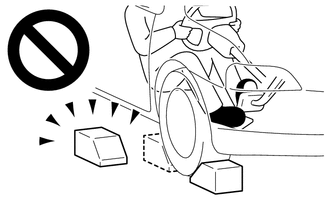
- Do not perform a stall test if a wheel chock is not in the correct position.
- The vehicle may move suddenly, which could result in a serious accident.
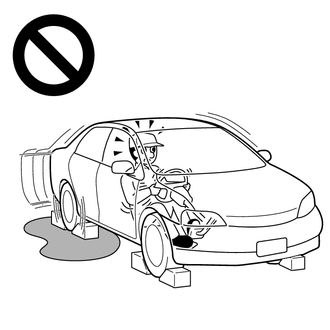
- Do not perform the stall test on a slippery or low-friction surface, as the wheels may slip.
- The vehicle may move suddenly, which could result in a serious accident.
NOTICE:
- This test must be performed after checking and confirming that the engine is normal.
- Perform this test when the CVT fluid temperature is between 50 and 100 °C.
- Perform this test with the air conditioning turned off.
- Do not perform the stall speed test for more than 5 seconds.
- When performing the stall speed test more than once, be sure to wait at least 15 seconds between tests.
- Perform this test with the AUTO function (function associated with gear shifting) of the electronic parking brake system set to OFF.
STALL SPEED TEST
HINT:
This test is intended to check the overall performance of the engine.
(a) Connect the Techstream to the DLC3.
(b) Start the engine.
(c) Turn on the Techstream.
(d) Select the following menus: Powertrain / Engine and ECT / Data List.
Powertrain > Engine and ECT > Data ListA/T Oil Temperature 1
(e) Drive the vehicle until the CVT fluid temperature reaches 50 to 100 °C.
(f) Let the engine idle with the air conditioning turned off.
(g) Chock all 4 wheels.
(h) Select the following menus: Powertrain / Engine and ECT / Active Test / Connect the TC and TE1.
Powertrain > Engine and ECT > Active TestConnect the TC and TE1
(i) Apply the parking brake and firmly hold the brake pedal depressed with the left foot.
HINT:
When the Electric Parking Brake Switch Assembly is pulled toward the lock side twice (2 lock operations), the maximum braking force is applied.
(j) Move the shift lever to the D position.
(k) Fully depress the accelerator pedal with the right foot.
(l) Read the engine speed (stall speed) and immediately release the accelerator pedal.
Stall speed:
2,200 +/- 300 rpm