Precautions
PRECAUTION
IGNITION SWITCH TERMS
(a) The type of ignition switch used varies depending on vehicle specifications. The terms listed in the table below are used in this section.
Term | Ignition Switch (Position) | Engine Switch (Condition) |
|---|---|---|
Ignition Switch in OFF position |
LOCK |
OFF |
Ignition Switch in ON position |
ON |
ON (IG) |
Ignition Switch in ACC position |
ACC |
ON (ACC) |
Starting the engine |
START |
Start |
IF ANY OF THE FOLLOWING CONDITIONS IS MET, RUN THE ENGINE AT IDLE WITH THE A/C ON (ENGINE SPEED BELOW 2,000 RPM) FOR AT LEAST 2 MINUTES
- Refrigerant gas top-up performed or A/C parts replaced.
- A significant amount of time has elapsed since the engine was stopped.
NOTICE:
If the engine speed exceeds 2,000 rpm, the A/C compressor may be damaged.
DO NOT HANDLE REFRIGERANT IN A CLOSED AREA OR NEAR AN OPEN FLAME
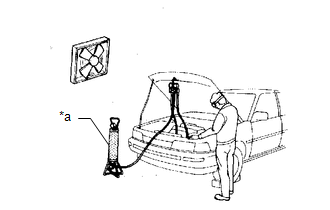
*a |
Charging cylinder |
ALWAYS WEAR SAFETY GLASSES
TAKE CARE TO AVOID CONTACT OF LIQUID REFRIGERANT WITH THE EYES OR SKIN
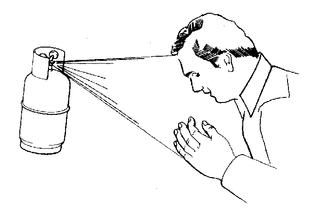
If liquid refrigerant gets into the eyes or onto the skin.
(a) Flush thoroughly with cold water.
CAUTION:
Do not rub the eyes or skin.
(b) Apply green grease to the skin.
(c) Consult a doctor or hospital immediately for appropriate care or treatment.
NEVER HEAT THE CYLINDER OR EXPOSE IT TO AN OPEN FLAME
TAKE CARE NOT TO DROP THE CYLINDER OR SUBJECT IT TO IMPACT
DO NOT OPERATE THE COMPRESSOR WHEN THE AMOUNT OF REFRIGERANT IN THE SYSTEM IS INSUFFICIENT
If the refrigerant in the air conditioning system is insufficient, oil lubrication will also be insufficient and the compressor may be damaged.
Take care to avoid this risk.
DO NOT OPEN THE HIGH-PRESSURE MANIFOLD VALVE WHILE THE COMPRESSOR IS RUNNING
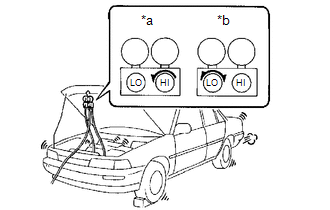
*a |
Incorrect |
*b |
Correct |
Operate only the low-pressure valve.
If the high-pressure valve is opened, refrigerant flows in the reverse direction, causing the charging cylinder to rupture.
PRECAUTIONS FOR HFO-1234yf [R1234yf] REFRIGERANT (with Toyota Safety Sense P)
(a) PRECAUTIONS TO OBSERVE FOR HFO-1234yf [R1234yf] REFRIGERANT
Click here
TAKE CARE NOT TO CHARGE TOO MUCH REFRIGERANT INTO THE SYSTEM
If too much refrigerant is charged into the system, problems such as insufficient cooling, increased fuel consumption, engine overheating, etc. will occur.
DO NOT OPERATE THE ENGINE OR THE COMPRESSOR WITHOUT REFRIGERANT.
CAUTION:
This may damage the inside of the compressor because the compressor parts move constantly, whether the air conditioning system is on or off.
SUPPLEMENTAL RESTRAINT SYSTEM (SRS)
The vehicle is equipped with a supplemental restraint system (SRS). Failure to follow the correct order of service operations may cause the SRS to deploy accidentally during service, resulting in a serious accident. Before performing any service (removal or installation of parts, inspection or replacement), carefully read the precautions.
Click here
GENERAL PRECAUTIONS
While using the battery during inspection, do not bring the positive (+) and negative (-) probes of the tester too close to each other, to avoid the risk of a short circuit.
CAUTION / NOTICE FOR REPLACING INSTRUMENT CLUSTER ASSEMBLY
When replacing the instrument cluster assembly, always use a new part. If an instrument cluster assembly that was installed in another vehicle is used, the stored information will not match the information transmitted by the vehicle, and a DTC may be stored.