Evaporative Emission Control System
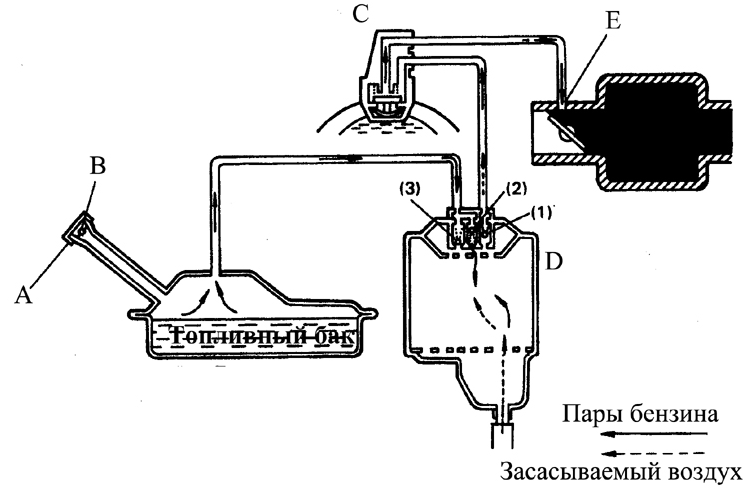
Evaporative Emission Control System
A. Filler cap
B. Check valve
C. Thermal vacuum valve
D. Charcoal canister
E. Purge port
Valve Operation Modes
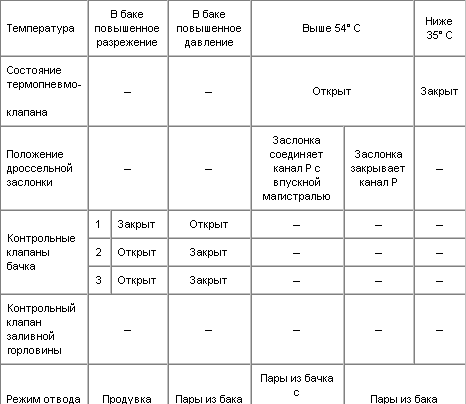
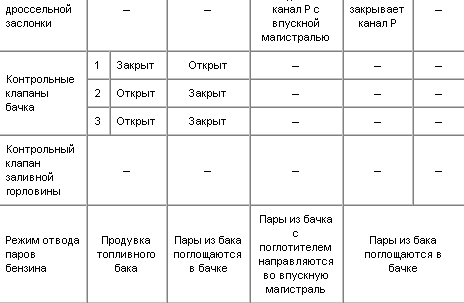
This system is designed to capture gasoline vapors from the fuel tank, throttle body chamber and intake manifold, thereby preventing hydrocarbons from being released into the atmosphere.
The system consists of a charcoal canister (activated carbon), hoses connecting the canister to the fuel tank, a thermal vacuum valve and a check valve.
When the engine is off, fuel vapors flow from the tank and throttle chamber into the canister, where they are adsorbed. When the engine starts, the canister is purged by air drawn in by the engine; the vapors are carried by this flow and burned in the combustion chamber.
The canister is equipped with three ball valves assembled in one housing. Depending on engine operating mode and fuel tank pressure, the ball valves connect or disconnect the tank from the thermal vacuum valve (which is connected in series with the throttle body chamber).
Inspection
PROCEDURE
1. Faults in the system such as a faulty check valve, damaged charcoal canister, delaminated or cracked hoses, or incorrectly connected hoses cause unstable idle and reduced engine performance. Inspect the condition of the fuel filler cap gasket (refer to subsection 5.7).
2. Obvious fuel loss or fuel odor in the cabin may be caused by fuel line leaks, cracks or other damage to the charcoal canister, a faulty check valve, or disconnected, incorrectly connected, pinched, chafed or mechanically damaged hoses.
3. Inspect each hose connected to the canister along its entire length. Replace the hose if necessary.
4. Check for fuel leaks at the bottom of the canister. If there is a leak, replace the canister and check the condition and connection of the hoses.
5. Inspect the canister. If cracks or mechanical damage are found, replace the canister.
6. Check the filter for cleanliness and the check valve for proper operation. Apply low-pressure air to the canister purge tube. Air must pass freely from the other tubes. Otherwise, replace the canister.
7. Check the operation of the thermal vacuum valve. With the engine completely cold, apply air from a hand pump to port A. The thermal vacuum valve must not pass air. Warm up the engine to a temperature of at least 55 °C. The valve must now pass air. Otherwise, replace the thermal vacuum valve.
Charcoal Canister Replacement
PROCEDURE
1. Disconnect the hoses from the reservoir, marking them beforehand.
2. Remove the mounting bolts, lower the reservoir together with the bracket, disconnect the hoses from the control valve, and remove the reservoir from the vehicle.
3. Install in the reverse order of removal.
Test yourself
A quick Toyota Corolla quiz: every answer comes with an explanation and a link to the manual page.