Tyres - Care
Proper tire care is essential for the driving safety of the Volvo S80 (2nd generation, 2013–2016). This section explains how tire type, tire pressure and tread depth affect handling and provides tips for checking the age and condition of the tires. It also covers maintenance intervals, correct storage and rotating the tires. This promotes even wear and reduces the risk of tire damage.
The functions of a tire include carrying the vehicle load, providing grip on the road surface, damping vibrations, and protecting the wheel from wear.
Driving characteristics
The tires have a major influence on the vehicle's handling. Tire type, tire size, tire pressure and speed rating are important for vehicle performance.
Tire age
All tires that are older than 6 years should be checked by a specialist, even if they appear undamaged.
Tires age and become brittle even when they are rarely used or not used at all. Their function can then be impaired. This applies to all tires that are kept for future use. Examples of external signs that a tire is not fit for use are cracks or discoloration.
New tires
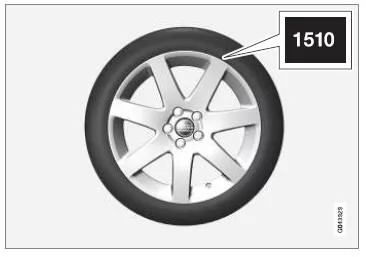
The date of manufacture is important for tires. Tires can harden after a few years, and their friction properties can decrease over time. When replacing tires, make sure you get tires that are as new as possible. This is especially important for winter tires. The last digits of the number sequence indicate the week and year of manufacture. This is the DOT (Department of Transportation) code on the tire, which is given as four digits, e.g. 1510. The tire in the illustration was manufactured in week 15 of 2010.
Summer and winter tires
When switching from summer to winter tires (or vice versa), mark the position in which each tire was fitted, e.g. L for left and R for right.
Wear and maintenance
Correct tire pressure results in more even wear. Driving style, tire pressure, climate and road surface condition affect how quickly the tires age and wear.
To prevent differences in tread depth and to avoid uneven wear patterns, the front and rear tires can be swapped regularly. The first swap should be carried out after approx. 5,000 km, then every 10,000 km.
If you are unsure about tread depth, Volvo recommends having it checked by a Volvo Retailer. If a significant difference in wear (more than 1 mm difference in tread depth) has already developed between the tires, always fit the least worn tires at the rear. A front-wheel slide is normally easier to correct than a rear-wheel slide.
Instead of the rear of the vehicle sliding sideways and possibly losing control of the vehicle completely, the vehicle continues straight ahead. For this reason, it is important that the rear wheels never lose traction before the front wheels.
WARNINGA damaged tire can cause loss of control of the vehicle.
Storage
Do not store wheels with mounted tires standing upright. Always store them lying down or hanging.
Related information
- Tires - Sizes
- Tires - Speed ratings
- Tires - Load index
- Tires - Rotation direction
- Tires - Wear indicator
Correct tire care on the Volvo S80 (2nd gen) contributes significantly to the safety and service life of the tires. Regular tire pressure checks, careful driving and observing the tire age are essential. Even unused tires age and can lose their function.
To prevent uneven wear, Volvo recommends regularly swapping the front and rear tires. Especially important: always fit the tires with the best tread to the rear to prevent the vehicle from sliding out.
FAQ
How do I recognize old or damaged tires?
By visible cracks, discoloration or brittle material. The DOT date also shows the age of the tire.
How should tires be stored?
Always lying down or hanging, not standing upright, to avoid deformation.
Test yourself
A quick Volvo S80 quiz: every answer comes with an explanation and a link to the manual page.