Sensors
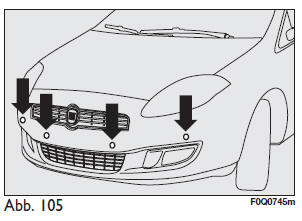
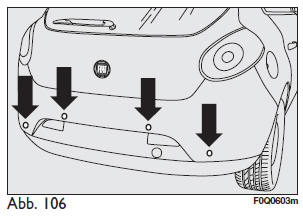
To detect the distance to obstacles, the system uses 4 sensors located in the front bumper (where fitted), Fig. 105, and 4 sensors located in the rear bumper, Fig. 106.
Version with 4 sensors
In the version with 4 rear sensors, the system activates automatically when reverse gear is engaged.
Version with 8 sensorsIn the version with 4 rear and 4 front sensors, the system activates when reverse gear is engaged or when the buttons Fig. 106.

When reverse gear is disengaged, the rear and front sensors remain active until a speed of 15 km/h is exceeded, so that the parking manoeuvre can be completed.
The system can also be activated by pressing the buttonsFig. 106 on the small
centre console. When the system is active, the LED on the button lights up.
The sensors are deactivated by pressing the buttonagain, or
when the speed of 15 km/h is exceeded. When the system is not active, the LED on the button goes out.
When the sensors are active, the front or rear buzzers sound a warning tone as soon as an obstacle is detected; the closer the obstacle, the faster the tones.
When the obstacle is less than 30 cm away, a continuous warning tone sounds.
Depending on the position of the obstacle (front or rear), the tone is emitted by the corresponding buzzers (front or rear). The nearest obstacle is always reported.
The signal stops immediately when the distance to the obstacle increases. The tone cycle remains constant if the distance measured by the centre sensors does not change, while for the side sensors the signal is interrupted after about 3 seconds in this condition, for example to avoid alerts when parking alongside walls.
 Note
The driver is always responsible for parking and other hazardous manoeuvres. When performing these manoeuvres, the driver must always make sure that there are no people (especially children) or animals in the area. The parking sensors are an aid for the driver, but the driver must never reduce their attention during potentially hazardous manoeuvres, even when they are performed at low speed.
Test yourself
A quick Fiat Bravo quiz: every answer comes with an explanation and a link to the manual page.