Airbag system function. Noise and smoke. It is prohibited to install a child restraint system on the front passenger seat. Airbag warning lamp
Side airbags in the Kia Opirus are integrated into the front seats and provide targeted protection for the chest and pelvis in a side impact. Their precise positioning within the seat structure ensures that the airbags respond quickly and effectively. This section explains the deployment mechanisms and safety precautions, for example regarding seat covers or subsequent installation. This ensures that the system continues to function reliably even after years of use.
Airbag System Function
- The airbag function is only available when the ignition is switched on or in the ignition switch position START.
- Airbags are deployed immediately when a sufficiently strong impact force is detected. This protects the occupants from serious injury.
- Airbags are not only deployed at a certain vehicle speed.
The main factors that determine airbag deployment are impact severity and impact angle.
- Ultimately, the combination of several factors, including
Vehicle speed, impact angle, impact severity and the stiffness of the object involved in the collision determine whether the airbags deploy.
Other factors may also influence the decision to deploy the airbags.
- Pressure in the front airbags builds up and is released again within a fraction of a second.
The human eye can hardly perceive the brief inflation of an airbag during a collision. Rather, after a collision, occupants only see the deflated airbag hanging out of its storage compartment.
- To provide protection in a severe collision, airbags must deploy extremely quickly. Only because airbags deploy within a short period of time can they provide protection. Therefore, a high deployment speed is a mandatory design requirement for airbags.
However, the high deployment speed also means that airbags inflate with great force. This can cause injuries, typically abrasions, bruises and bone fractures.
- Under certain circumstances, a driver airbag can cause serious injuries. This applies in particular when the driver has adopted a seating position that places them extremely close to the steering wheel.
- The driver should sit as far away from the steering wheel as possible (min. 250 mm) to reduce the risk of serious or fatal injuries in the event of a collision.
- The front passenger should always move the seat as far back as possible and sit upright.
- In a collision, airbags can deploy immediately, so persons who are not seated properly may be injured.
- Airbag deployment can cause the following injuries: abrasions to the face and body, injuries from broken eyeglass lenses, and burns from the igniters.
Noise and smoke
When an airbag deploys, a loud bang occurs in the vehicle and a cloud of smoke and dust is released. This is a normal process caused by the pyrotechnic igniter of the airbag. Immediately after an airbag inflates, you may have difficulty breathing due to the pressure exerted on your chest by the seat belt and the airbag, as well as from inhaling the smoke and dust from the explosion. We therefore strongly recommend opening the doors and/or windows as soon as possible after a collision with airbag deployment so that fresh air is available to you.
Although the smoke and dust are not toxic, they can cause irritation of the skin, eyes and respiratory tract.
Therefore, wash with cold water as soon as possible and see a doctor if the symptoms persist.
WARNINGImmediately after the airbags have been deployed, the associated components in the steering wheel and dashboard are very hot. Therefore, do not touch the airbag module areas immediately after deployment.
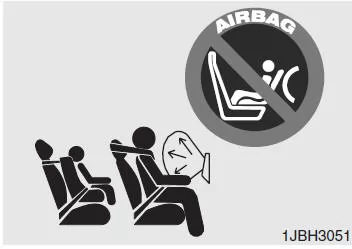
It is prohibited to install a child restraint system on the front passenger seat
Never install a rear-facing child seat on the front passenger seat. In the event of airbag deployment, the airbag would strike the rear-facing child seat. This could result in serious or fatal injuries.
Never install a forward-facing child seat on the front passenger seat. The inflating front passenger airbag could seriously or fatally injure a child restrained in the child seat.
WARNING- Never install a child restraint system on the front passenger seat. The inflating front passenger airbag could cause serious or fatal injuries.
- If you install child seats without ISOFIX anchorages on the outer seats of a rear seat bench equipped with side airbags, position these child seats as far as possible from the doors toward the center of the vehicle and secure them firmly so that they stay in this position. Inflating side or head airbags could cause serious or fatal injuries due to their sudden deployment.

Airbag warning lamp
The airbag warning lamp in the instrument panel is designed to alert you to possible faults in the airbag system.
After switching on the ignition (ignition switch in ON position), the airbag warning lamp should flash for approx. 6 seconds and then go out.
Have the system checked if:
- the airbag warning lamp does not flash for approx. 6 seconds after switching on the ignition.
- the airbag warning lamp remains on after starting the engine.
- the airbag warning lamp comes on while driving.
The airbags of the Kia Opirus 2003–2011 are precisely designed to provide the best possible protection in dangerous situations. The system responds to factors such as impact angle and severity, thereby protecting the occupants efficiently.
The noise and smoke produced when the airbags deploy are normal and nothing to be concerned about. It is important that child seats are never installed on the front passenger seat to ensure children's safety.
FAQWhy must no child seat be installed on the front passenger seat?
Because the inflating airbag could seriously injure a child.
What to do if smoke develops after airbag deployment?
Open the doors or windows and let fresh air into the vehicle.
Test yourself
A quick Kia Opirus quiz: every answer comes with an explanation and a link to the manual page.