Why did my airbag not deploy in a collision?
The front airbag system in the Kia Opirus (2003–2012) protects the driver and front passenger in a frontal impact. It is deployed only when the severity of the accident warrants it, thanks to intelligent sensors that distinguish between dangerous and harmless situations. The system also provides a deactivation function for the front passenger airbag, for example when a rear-facing child seat is used. This combination of protection and adaptability makes the system particularly reliable.
(Conditions for deployment or non-deployment of the airbag)
There are many types of accidents in which an additional protective effect of the airbag cannot be expected.
This includes rear-end collisions and follow-on collisions in multi-vehicle accidents, as well as collisions at low speed. It is therefore possible that your vehicle was slightly or severely damaged but the airbags did not deploy.
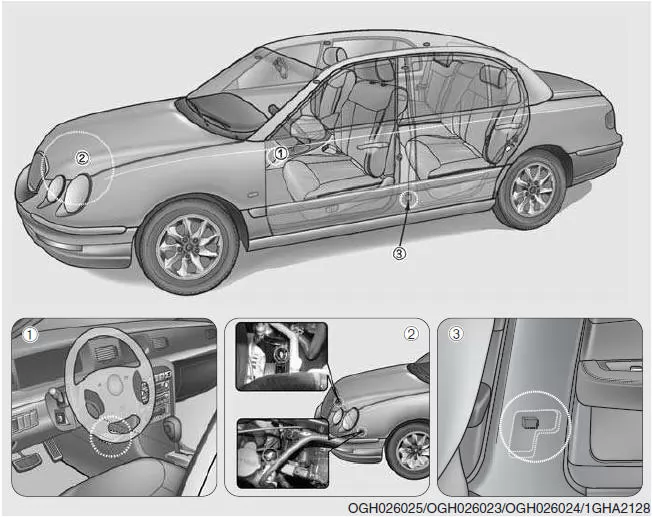
Airbag impact sensors
- SRS control module
- Front impact sensor
- Side impact sensor
- Do not strike the areas where the airbags or impact sensors are located, and do not allow objects to hit these areas. This could cause the airbags to deploy unexpectedly, which could result in serious or fatal injury.
- If the installation position or mounting angle of the impact sensors is changed in any way, the airbags could deploy at an unexpected time or fail to deploy in a collision. This could result in serious or fatal injury. Therefore, never attempt to perform work on or near the impact sensors. Have the airbag system inspected and repaired by an authorized Kia dealer.
- Problems can occur if the mounting angles of the impact sensors change due to deformation of the front bumper, the body or the B-pillar, since the impact sensors are attached to these components. Have your vehicle inspected and repaired by an authorized Kia dealer.
- Your vehicle is designed to absorb a certain amount of impact energy and to deploy the airbags in certain collisions. If the bumper is modified by installing additional protective devices available on the aftermarket, or if the bumper is replaced with a non-original component, the impact behavior and airbag control may be seriously affected.

Conditions for airbag deployment
Front airbags
The front airbags (driver and front passenger airbags) are designed to deploy in certain frontal collisions, taking into account impact severity, speed and impact angle.
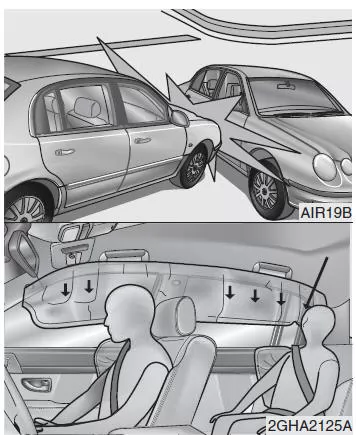
Side airbag*
Side and/or curtain airbags are designed to deploy in certain side collisions or vehicle rollovers, taking into account impact severity, speed and impact angle.
Although the driver and front passenger airbags are designed to deploy only in certain frontal collisions, they may deploy in other collisions in which the impact force on the front impact sensors exceeds a certain level.
Although the side and/or curtain airbags are designed to deploy only in certain side collisions, they may deploy in other collisions in which the impact force on the side impact sensors exceeds a certain level.
In other words, airbags may deploy in accident situations such as: a diagonal frontal impact, a collision with a higher vehicle such as a truck, where the front of your vehicle may go under the truck, an impact with a pole or post, and a vehicle rollover. Always drive carefully.
Airbags may also deploy if the vehicle body is subjected to an impact while driving off-road. Therefore, drive with particular care on unpaved surfaces that are not intended for passenger cars.
To protect the occupants, the front airbags and seat belt pretensioners may also deploy in certain side collisions.
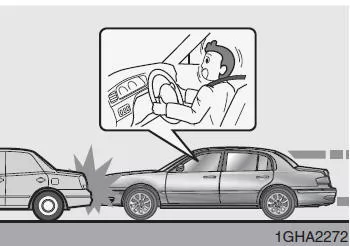
Conditions for airbags not deploying
- In certain collisions, the airbags will not deploy because the seat belts provide adequate protection for the occupants. In some low-speed collisions, deploying airbags could cause a secondary impact to the occupants, which could result in minor abrasions, cuts or burns, or loss of control of the vehicle.
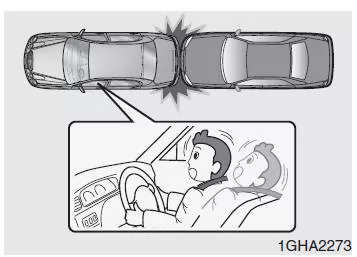
- The airbags may not deploy in a rear-end collision. Because occupants are thrown backward rather than forward in an impact from behind, airbags cannot provide additional protection in this situation.
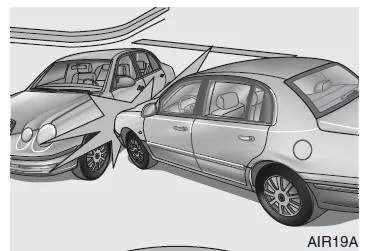
- The front airbags may not deploy in a side collision.
Because occupants are thrown in the direction of a side impact, the front airbags cannot provide additional protection in this situation.
However, the side or curtain airbags* may deploy in this situation, depending on impact severity, vehicle speed and impact angle.
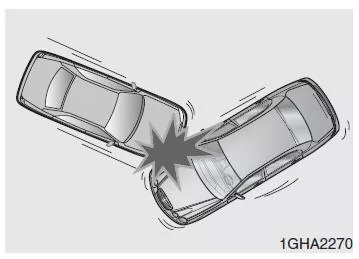
- In a diagonal frontal collision, the impact force is comparatively lower than in a direct frontal collision along the direction of travel.
Therefore, the airbags may not deploy in a diagonal frontal collision.
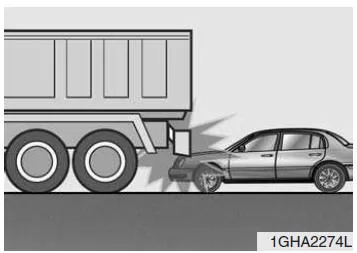
- Before a collision, the driver instinctively applies the brake forcefully. During such an emergency braking, the vehicle pitches forward under braking force, so that the front of the vehicle may go under a higher vehicle.
The airbags may not deploy in such a situation, because the impact sensors cannot detect any impact force, or not enough impact force.
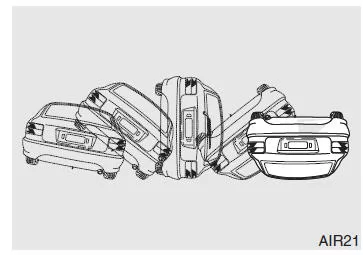
- The front airbags may not deploy during a vehicle rollover, because the front airbags cannot provide additional protection in this situation.
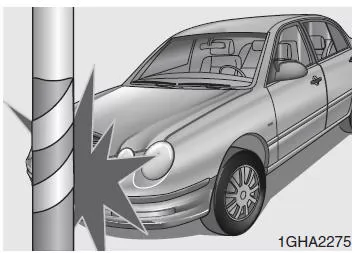
- Airbags may not deploy in a collision with a pole or tree. The impact is concentrated at one point, so the impact force reaching the crash sensors is not strong enough to trigger deployment.
The airbag system of the Kia Opirus 2003–2011 is designed to deploy only in certain types of accidents. These mainly include severe frontal or side collisions where additional restraint systems are required.
The precise calibration of the sensors and the intelligent evaluation logic prevent unnecessary airbag deployment, thus contributing to the safety and durability of the system.
Knowledge of the deployment conditions helps you to better understand and appreciate the system. This makes the Kia Opirus a particularly safe vehicle in its class.
Test yourself
A quick Kia Opirus quiz: every answer comes with an explanation and a link to the manual page.