What airbags are designed to do. Why using seat belts is important. The components of the airbag system. Driver airbag
Airbags in the Kia Opirus are intended as a supplement to seat belts, not as a replacement for them. In severe collisions they additionally protect the head and chest area, but they only achieve their full effect in combination with properly worn seat belts. This section describes the operation, limits and components of the system. It also emphasizes why seat belts must be worn in every driving situation to ensure maximum safety in frontal and side impacts.
What airbags are designed to do
The front airbags (driver and front passenger airbags) are designed to supplement the protective effect of the seat belts in certain frontal collisions. In addition, the side airbags and head airbags* are designed to supplement the protective effect of the seat belts in side collisions.
The seat belts are designed to reduce the risk of injury to the driver and front passenger in less severe collisions. However, if the impact is so severe that the seat belts alone can no longer reduce the risk of injury, the airbags supplement the protective effect in the head and chest area.
What airbags cannot do
Due to their design, the airbag system supplements the protective effect of the seat belts. THE AIRBAG SYSTEM IS BY NO MEANS A REPLACEMENT FOR SEAT BELTS.
Why using seat belts is important
There are four important reasons to wear seat belts, even when the vehicle is equipped with airbags. The seat belts:
- help keep you in a favorable seating position and at the same time keep you away from the deploying airbag.
- reduce the risk of injury in rollovers, certain side collisions and rear collisions, since the airbags cannot protect in these situations and are therefore not deployed.
- protect in certain frontal and side collisions that are not severe enough to deploy the airbags.
- reduce the risk of being thrown out of the vehicle.
NOTE - Data recorder*
The airbag control module in your vehicle is equipped with a data recorder. It stores information about the use and status of the driver and front passenger seat belts in certain collisions.
CAUTION - Airbags and seat belts- Even if your vehicle is equipped with airbags, you and your passengers must always wear the seat belts provided to minimize the risk and severity of injuries in the event of a collision or rollover.
- Always fasten your seat belt. The seat belt can help keep you away from the deploying airbags in the event of a collision.
- If vehicle occupants are not belted or have assumed an incorrect seating position, they may not be adequately protected. Serious and fatal injuries may result.
- The driver and front passenger airbags are designed to deploy only in certain frontal collisions. Side and head airbags* are designed to deploy only in certain side collisions. Below a certain impact force and in rollovers, the airbags do not deploy and therefore cannot provide protection in these cases. They also may not deploy if a further impact occurs in a multiple-collision event after the airbags have already been deployed.
- If your vehicle has been damaged, for example by flooding or for other reasons, so that the floor covering inside the vehicle is wet or water is standing in the vehicle, do not try to start the engine and do not insert the ignition key into the ignition switch before the battery has been disconnected. This could trigger the airbags and cause serious or fatal injuries. In this case, have your vehicle towed to an authorized KIA dealer and have the necessary inspections and repairs carried out.
Components of the airbag system
The main components of your airbag system are:
- Airbag covers marked "SRS AIRBAG". The marked airbag covers show the installation location of the various airbags.
- Driver airbag
- Front passenger airbag
- Side airbag
- Head airbag
- A self-diagnosis system that constantly monitors system function.
- A warning lamp that illuminates in the event of a possible system malfunction.
- An airbag backup power supply to trigger the airbags if the main power supply is interrupted during a collision.
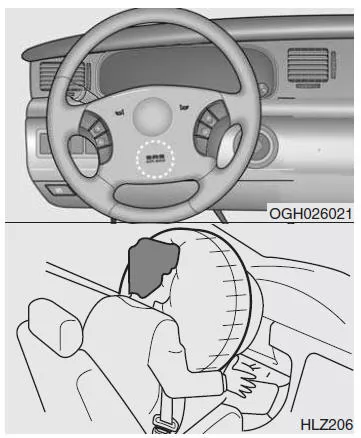
Driver airbag
The driver airbag is located in the steering wheel pad in the center of the steering wheel.
WARNING- Always adopt a seating position that is as far as possible from the steering wheel (distance between the upper body and the steering wheel at least 250 mm) while still sitting comfortably, so that you can steer easily and reach all controls. This reduces the risk of serious or fatal injury in a collision.
- Do not place any objects on or in front of the airbag covers. Airbags deploy with great force and high speed, so such objects could be thrown at you. This could result in serious or fatal injuries.
- Do not attach stickers, ornaments or other objects to the steering wheel pad. Such objects could affect airbag deployment.
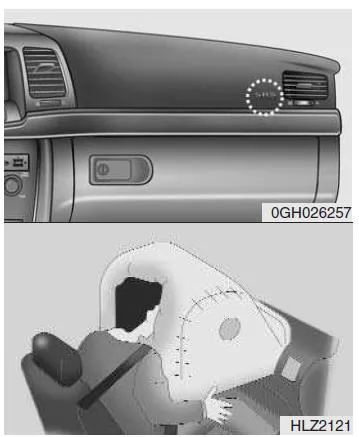
The airbag system of the Kia Opirus 2003–2011, in combination with the seat belts, provides a comprehensive protection concept. It reduces the risk of injury in severe collisions and ensures that drivers and passengers are protected as well as possible.
Seat belts remain indispensable, as airbags only supplement them. Together they form a strong team for your safety in the Kia Opirus.
FAQWhen do the airbags in the Kia Opirus 2003–2011 deploy?
They deploy in certain frontal and side collisions, but not in all types of accidents.
Why are seat belts important despite airbags?
Because they ensure optimal protection and prevent occupants from being injured by the airbag.
Test yourself
A quick Kia Opirus quiz: every answer comes with an explanation and a link to the manual page.