Automatic Light Sensor
Repair Procedures
Inspection
Check whether the automatic light control operates as shown in the timing chart below. The tail lamp and headlamp (Low) are controlled based on the input of the auto light sensor (illumination intensity) when the auto light switch on the multifunction switch is on and the vehicle is in IGN1 or IGN2 ON mode. If IGN1 = ON, the BCM detects this voltage, and if the voltage exceeds the rated range, an automatic light malfunction occurs (below 4 V or above 6 V).
In IGN1 ON state, when the multifunction switch module detects auto light ON, the tail lamp relay output and low beam relay output are controlled according to the input signal of the auto light sensor. Automatic light control does not operate if the sensor power supply pin (regulated 5 V power from IGN1 to the light sensor) is shorted to ground. If IGN1 is ON, the BCM monitors the range of this power supply and sets a malfunction as soon as the voltage goes out of the permissible range. This malfunction then occurs, and while it is present, the headlamps must be turned on regardless of the sunlight level detected by the sensor. This is designed to prevent the headlamps from turning off when the malfunction occurs at night.


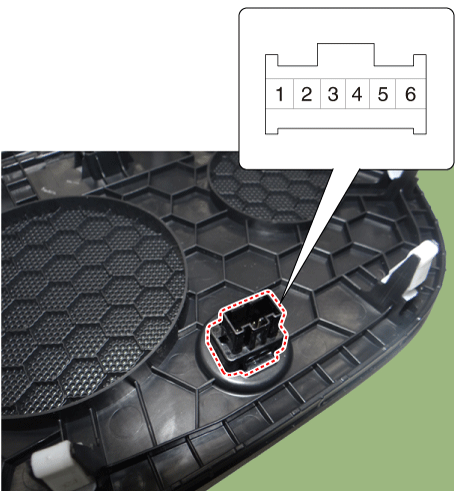
Removal
Disconnect the negative (-) battery terminal.
Using a scraper or remover, remove the center airbag speaker grille (A).

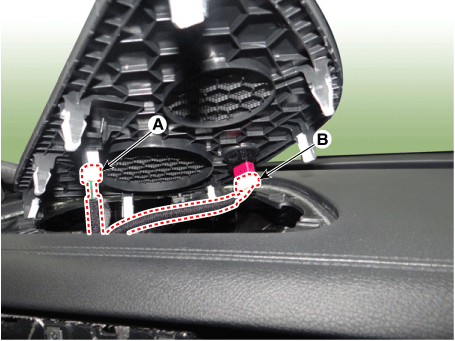
Disconnect the airbag connector (A) and the auto light and photo sensor connector (B).
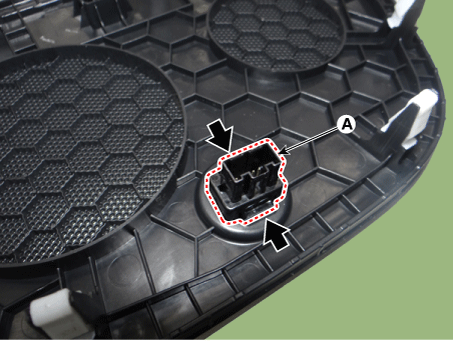
Remove the auto light sensor (A) after releasing the fixing hooks.
Installation
Install the auto light sensor.
Connect the airbag connector and the auto light and photo sensor connector.
Install the center speaker grille.
Connect the negative (-) battery terminal.
Test yourself
A quick Kia Stinger CK quiz: every answer comes with an explanation and a link to the manual page.