Integrated Memory System (IMS)
Specifications
Specifications
Power Seat with Memory
| Item | Specifications |
| Rated Voltage | 12 V DC |
| Operating Voltage | 9–16 V DC |
| Operating Temperature Range | -22 - 167°F (-30 - 75°C) |
| Dark Current | Max. 1.2 mA |
Power Seat Memory Switch
| Item | Specifications |
| Rated Voltage | 12 V DC |
| Type | Soft click feel |
| Operating Temperature Range | -22 - 176°F (-30 - 80°C) |
Components and Component Location
Components
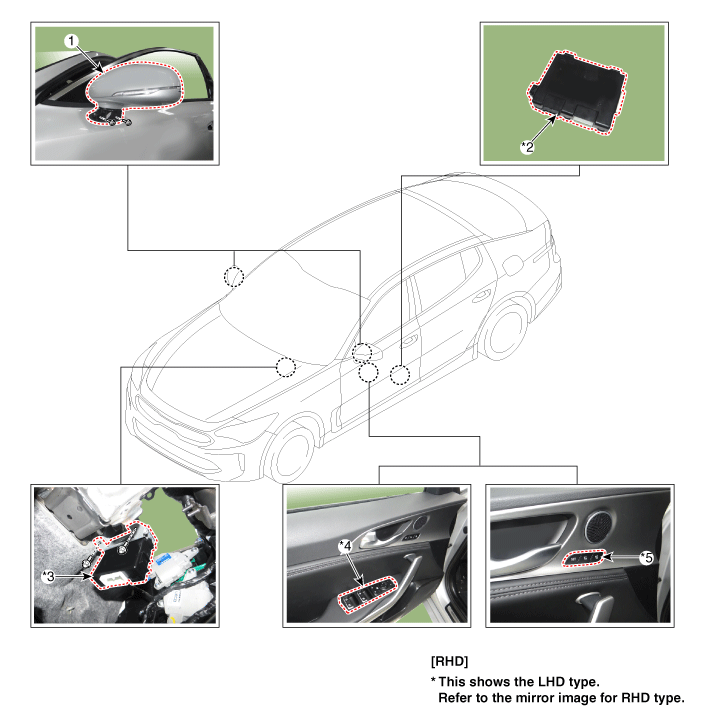
| 1. Outside rear view mirror 2. Power Seat Memory Module (PSM) 3. Steering Control Module (SCM) |
4. Driver Door Module (DDM) 5. IMS Mirror Control (driver power window switch) |
Circuit Diagrams
Components

Description and Operation
Description
The optimal seat position set by the driver is stored in the power seat device using the IMS switch. If the position is changed, the seat can recall its preset position using the IMS switch.
It has safety functions to prohibit the process during driving and to stop linked movement in an emergency.
The main functions are as follows.
Manual Operation: Motor operation using the manual seat switch.
The seat position is changed by the motor when a signal is input from the manual seat switch (slide, tilt, front tilt, height-adjustable seat cushion).
Memory function: Available to store/recall data for two persons with the IMS switch.
Memory recall of the optimal seat position set by the driver based on CAN data from the "DDM → IMS" module with the IMS switch.
Recall via CAN of data received from the DDM when the IMS switch is operated.
Ignition-Linked Movement
This function links movement depending on the engine ON/OFF state.
Using MS IN data transmission.
Start conditions: When power is turned off, the vehicle is in ACC.
Operation
Recall Movement
If recall CAN data is received from the DDM, the buzzer sounds once and the seat automatically moves to the stored position.
Stored CAN data that has not been memorized does not perform the recall function.
If CAN data is received again during a previous data recall, the last received data has priority.
If recall CAN data is received by pressing button 1 or 2 during recall, the seat stops the recall process.
If the memory CAN data is received by pressing the SET button during recall, the seat stops the recall process.
Automatic stop when the restart switch is turned off during recall.
Do not start the engine if the difference between the stored recall position and the current position is less than 4 pulses.
Recall Prohibition Conditions
Playback is prohibited and control is stopped during playback if any of the following conditions is met.
IGN2 OFF (except for 30 seconds after opening or closing a door.)
Vehicle speed above 3 km/h
When the switch is operated manually
Operation Timing Chart
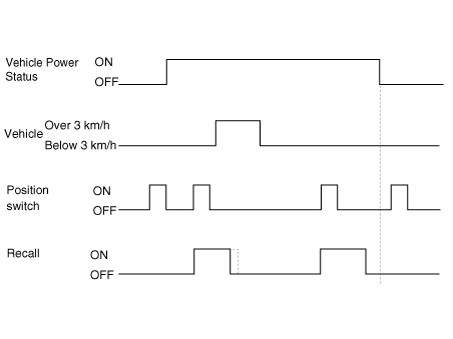
Operation Priority Decision
For automatic control, engine operation shall be delayed by 100 ± 10 ms to prevent overlap of the starting circuit. In this case, priority is given as follows.
Slide > Seatback Adjustment > Front Seat Height Adjustment > Rear Seat Height Adjustment > Cushion Extension Adjustment
Operation Timing Chart
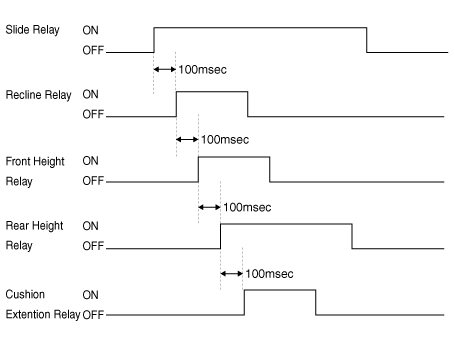
Operation is related to Entry / Exit.
Reverse movement when pushing and forward movement when pulling (applies to slide only).
It is available when the automatic SET message is transmitted from the driver's power seat switch (DDM) is turned on.
Operation starts when the engine is off and the driver's seat door is opened.
Movement to the target position at ACC ON.
Operation prohibition conditions.
Vehicle speed is 3 km/h or higher.
The power seat manual switch is activated.
Recall command is received when entering the vehicle.
Driver Setting Menu (USM) is off.
Test yourself
A quick Kia Stinger CK quiz: every answer comes with an explanation and a link to the manual page.