Markings on the Tire Sidewall
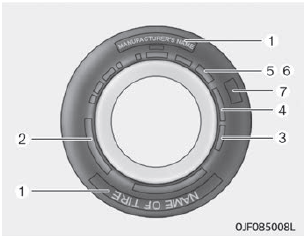
The basic properties of the tire are shown by this information. The TIN (Tire Identification Number) and certification of the applicable safety standard are also marked. The TIN can be used to identify the tire in case of a recall.
1. Manufacturer or Brand
The manufacturer or brand is marked on the tire sidewall.
2. Tire Size Designation
The tire size is marked on the sidewall. You need this information when selecting replacement tires for your vehicle. The tire size information is explained below, by individual letter and number.
Example of tire size marking:
(These figures are for example only; your tire size may vary depending on the vehicle.)
P235/55R19 108T
P - Applicable vehicle type (tires with the "P" prefix are intended for use on passenger cars or light commercial vehicles. However, not all tires with this marking are P-metric.)
235 - Tire width in millimeters.
55 - Aspect ratio. Tire section height as a percentage of its width.
R - Tire construction code (radial).
19 - Wheel diameter in inches.
108 - Load index; a numeric code that relates to the maximum load the tire can carry.
T - Speed rating symbol. For more information, refer to the corresponding table in this section.
Wheel Size Designation
Wheel size is also marked. You need this information when it is necessary to replace a wheel. The individual letters and numbers of the wheel size designation are explained below.
Example of wheel size designation: 7.5JX19
7.5 - Wheel width in inches
J - Rim flange contour
19 - Wheel diameter in inches.
Tire Speed Rating Code
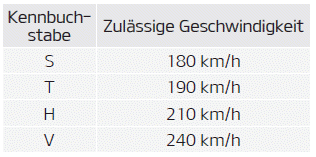
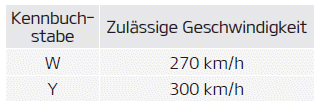
The table below lists the speed rating code letters currently in use and the maximum speed for automotive tires. The speed rating code is part of the marking on the tire sidewall. The code letter indicates the maximum permitted speed of the tire.
3. Determining Tire Age (TIN: Tire Identification Number)
Tires manufactured more than 6 years ago (including the spare) must be replaced with new tires. The date of manufacture can be read from the DOT code on the tire sidewall (sometimes on the inside). The DOT code is a sequence of numbers and letters. You can check the production date of the tire from the last four digits of the DOT code.
DOT: XXX XXX OOOO
The first two groups of the DOT code contain information about the manufacturer, tire size, and tread type. The last four digits of the DOT code indicate the calendar week and year of manufacture.
For example:
DOT XXXX XXXX 1618 means the tire was manufactured in the 16th week of 2018.
WARNING
Tire Aging
Tire condition deteriorates over time, even if the tires are not used.
Regardless of the remaining tread depth, we recommend replacing this tire after approximately six (6) years of normal use. Heat and hot climate conditions, or high loads due to heavy cargo, may accelerate the aging process. Failure to heed this warning may result in unexpected tire damage. This may cause loss of control of the vehicle, resulting in a serious or fatal accident.
4. Tire Construction and Materials
The number of plies of rubber-coated fabric layers in the tire. The materials used (steel, nylon, polyester, and others) must be specified by the tire manufacturer. The letter "R" denotes radial tires, the letter "D" denotes diagonal (bias) tires, and the letter "B" denotes belted tires.
5. Maximum Permissible Tire Pressure
This number indicates the maximum permissible pressure to which the tire may be inflated. Never exceed the maximum permissible tire pressure. Recommended tire pressure and load information can be found on the label on the vehicle.
6. Maximum Load Rating
The number indicates the maximum load in kilograms (and pounds) the tires can carry. If you need to replace the tires, always use tires with the same load capacity and speed rating as the original factory tires.
7. Uniform Tire Quality Grades
Tire quality grades, where applicable, are located on the sidewall between the tread shoulder and the maximum section width. For example:
PLY 200
TRACTION AA
TEMPERATURE A
Treadwear
The treadwear grade is the relative wear rate of the tire under controlled conditions, as required by law. For example, a tire with a treadwear grade of 150 wears one and a half (1½) times as fast as a tire with a treadwear grade of 100.
The actual tire life depends on the conditions of use, driving style, maintenance intervals, and road and climate conditions, which may differ significantly from the norm.
The treadwear grades refer to passenger car tires and are indicated on the sidewall. The tires (original or optional) fitted to your vehicle may differ in treadwear grade.
Traction Grades - AA, A, B and C
Traction grades are listed in descending order: AA, A, B and C. These letter grades represent the tire's ability to stop on wet pavement, based on controlled measurements on asphalt and concrete as required by law. A tire graded C offers relatively poor traction.
Temperature Grades - A, B and C
Temperature grades A (highest), B and C represent the tire's resistance to heat and its ability to dissipate heat, under controlled conditions on a test bench.
Sustained high temperatures can affect the tire material and shorten tire life. Excessively high temperatures may cause sudden tire failure. The temperature grades B and A indicate tires that meet the minimum requirements set by law for heat resistance tests.
WARNING
The traction value for this tire is based on straight-line braking traction tests only and does not consider acceleration, cornering, hydroplaning, or maximum traction characteristics.
WARNING
Tire Temperature
The temperature grade assumes that the tire is properly inflated and not overloaded. Excessive speed, underinflation and excessive loads, individually or in combination, can cause heat buildup and sudden tire failure. Control of the vehicle may also be lost. This may result in serious injury or death.
Test yourself
A quick Kia Stonic quiz: every answer comes with an explanation and a link to the manual page.