Markings on the Tire Sidewall
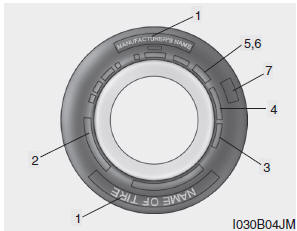
The information on this label identifies and describes the basic characteristics of the tire and provides the tire identification number (TIN), required for certification of safety standards. Always quote the TIN in any correspondence regarding tires.
1. Manufacturer name or brand
The manufacturer name or brand is shown.
2. Tire size designation
The tire size designation is located on the sidewall of the tire.
This information will be needed when replacing the vehicle's tires. The meaning of the letters and numbers used in the tire size designation is given below.
Example of a tire size designation: (The numbers shown here are examples only; tire size designations vary depending on the vehicle type.)
175/50R15 75H
175 - Tire width in millimeters. 50 - Aspect ratio. The height of the tire cross-section expressed as a percentage of the tire width. R - Tire construction code (radial tire). 15 - Wheel diameter in inches.75 - Load index, a numerical code associated with the maximum load the tire can carry.
H - Speed symbol. For additional information, refer to the speed rating chart in this chapter.
Wheel Size Designation
Important information needed when replacing a wheel is also marked on the wheels.
The meaning of the letters and numbers in the wheel size designation is given below.
Example of tire size designation:
5.5JX15
5.5 - Rim width in inches
J - Rim flange contour designation 15 - Rim diameter in inches
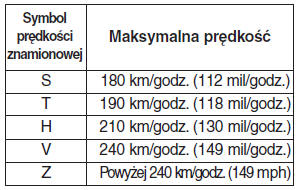
Tire speed ratings
The table below shows the various speed ratings currently used for passenger cars.
The speed rating is part of the tire size designation on the tire sidewall. This symbol corresponds to the maximum safe speed for the tire.
3. Tire age check (TIN: Tire Identification Number)
Tires that are more than 6 years old, based on their production date (including the spare tire), should be replaced with new ones. The production date can be found on the tire sidewall (preferably on the inside), where the DOT code is shown. The DOT code is a serial number containing numbers and English letters. The production date is indicated by the last four digits (characters) of the DOT code.
DOT : XXXX XXXX OOOO
The first part of the DOT code indicates the plant code, tire size and tread pattern, and the last four digits indicate the week and year of production.
For example: DOT XXXX XXXX 1614 means a tire produced in the 16th week of 2014.
WARNING - Tire Age Tires age over time, even when not in use. Regardless of the remaining tread depth, it is generally recommended that tires be replaced after six (6) years of normal use. Heat in hot climates or frequent heavy loads may accelerate the aging process.Failure to observe this warning may lead to sudden tire failure, which may result in loss of vehicle control and an accident causing serious injury or death.
4. Tire cord composition and material
The number of plies, i.e., layers of rubber-coated fabric cord, is shown on the tire. Tire manufacturers must also indicate the materials contained in the tire, such as steel, nylon, polyester and others. The letter "R" indicates radial construction. The letter "D" indicates diagonal (bias) construction, and the letter "B" indicates belted bias construction.
5. Maximum permissible inflation pressure
This number shows the maximum air pressure that may be in the tire. Do not exceed the maximum permissible inflation pressure. The recommended inflation pressure is shown on the tire and loading information label.
6. Maximum load
This number shows the maximum load in kilograms and pounds that the tire can carry. When replacing tires on the vehicle, always use tires with the same load rating as the tire fitted at the factory.
7. Uniform Tire Quality Grading - Treadwear
Quality grades, where applicable, can be found on the tire sidewall between the tread and the bead area, and the maximum section width.
For example:
TREADWEAR 400
TRACTION A
TEMPERATURE A
Treadwear
The treadwear grade is a comparative rating based on the tire's wear rate, determined under controlled conditions on a designated government test course.
For example, a tire graded 150 will wear 1.5 times longer on the government test course than a tire graded 100.
The actual tire life depends on the condition of the tire and how the tire is used. Actual tire wear may differ from the values given in the standards due to different driving habits, practices, and differences in road and climate conditions.
These grades are marked on the sidewalls of passenger car tires. Tires supplied as standard or optional equipment on the vehicle may have different grade values.
Traction - AA, A, B and C
Traction grades, from highest to lowest, are marked AA, A, B and C. These grades indicate the tire's ability to stop on wet pavement, measured under controlled conditions on government test tracks with asphalt and concrete surfaces. Tires marked C may have poor traction.
WARNING The temperature class of this tire is established for a tire that is properly inflated and not overloaded. Excessive loading, whether separately or in combination, may cause heat build-up and possible tire failure.Temperature - A, B and C
Temperature grades are marked A (highest), B and C. These grades represent the tire's resistance to heat generation and its ability to dissipate heat, determined by laboratory test track testing.
Sustained high temperature can cause tire deterioration and shorten tire life, and excessive temperature can lead to sudden tire failure.
Grades A and B represent higher levels of tire performance than the minimum required by law, as determined by laboratory test track testing.
WARNING - Tire Temperature The temperature class of this tire is designated for a tire that has correct pressure and is not overloaded. Excessive speed, insufficient pressure, or excessive loading, acting separately or in combination, may cause heat build-up and possible tire failure.This may lead to loss of vehicle control, resulting in serious injury or death.
Test yourself
A quick Kia Rio YB quiz: every answer comes with an explanation and a link to the manual page.