Wheel and Tire Replacement
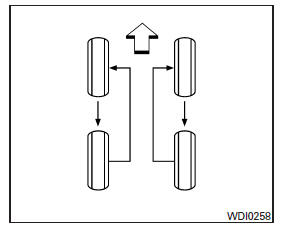
Tire Rotation
NISSAN recommends rotating the tires every 12,000 km (7,500 miles).
Refer to the "Flat Tire" section of the "In Case of Emergency" chapter of this manual for tire replacement instructions.
Using a torque wrench, tighten the wheel nuts to the specified torque as soon as possible.
Wheel nut tightening torque: 113 N·m
Wheel nuts must always be tightened to the specified torque. It is recommended to tighten the wheel nuts to the specified torque each time the tires are rotated.
WARNING
- After rotating the tires, check and adjust the tire pressure.
- Re-tighten the wheel nuts after driving 1,000 km (600 mi), or after a flat tire, etc.
- The spare wheel is not included in the tire rotation.
- For more information about tires, refer to the "Important Tire Safety Information (U.S.)" or "Tire Safety Information (Canada)" section of the Warranty Booklet.
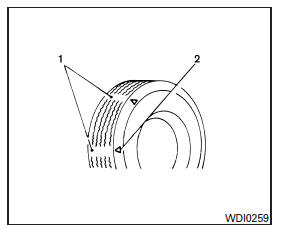
- Wear Indicator
- Mark
Tire Wear and Damage
WARNING
- The tires of your vehicle must be checked periodically for wear, cracks, bulges, or objects lodged between the treads. If there is significant wear, cracks, bulges, or deep cuts, the tire(s) must be replaced.
- Original tires are equipped with wear indicators built into the tread grooves.
When these indicators become visible, the tires must be replaced.
Wheel and Tire Replacement
When replacing a tire, use a tire with the same size, tread pattern, speed rating, and load capacity as the original tire.
The recommended tire types and sizes are listed in the "Wheels and Tires" section of the "Technical Specifications and Consumer Information" chapter of this manual.
WARNING
- Using tires other than those recommended, or mixing different brands or constructions (bias, belted, radial), or tires with different tread patterns, may affect driving, braking, the vehicle dynamic control system, ground clearance, clearance between the body and the tires, snow chain clearance, speedometer calibration, headlight alignment, and bumper height. Some of these effects may cause accidents and result in serious injury.
- If your vehicle was originally equipped with 4 tires of the same size and you want to replace only 2 of the 4 tires, install the new tires on the rear axle. Installing the new tires on the front axle may cause loss of vehicle control under certain driving conditions, resulting in an accident and serious injury.
- If wheels must be replaced for any reason, always replace them with wheels having the same offset. Wheels with a different offset may cause premature tire wear, compromise handling characteristics, affect the vehicle dynamic control system, or interfere with the brake discs and drums.
This interference may reduce braking efficiency or cause premature wear of the brake pads and shoes. Refer to the "Wheels and Tires" section of the "Technical Specifications and Consumer Information" chapter of this manual for wheel offset dimensions.
If the light remains on after one minute, contact your NISSAN dealer as soon as possible to replace the tires or reset the system.
Wheel Balancing
Unbalanced wheels may affect vehicle handling and reduce tire life. Even if the vehicle is used regularly, the wheels may become unbalanced.
For this reason, the wheels should be balanced as recommended.
The wheels must be removed from the vehicle to be balanced. Otherwise, the vehicle may be mechanically damaged.
- For more information about tires, refer to the "Important Tire Safety Information (U.S.)" or "Tire Safety Information (Canada)" section of the Warranty Information Booklet.
Wheel care
- To keep the wheels looking good, wash them when you wash your vehicle.
- Clean the inside surfaces of the wheels when they are removed or when you clean the underbody of the vehicle.
- Do not wash the wheels with abrasive cleaners.
- Regularly inspect the wheel rims for dents or signs of corrosion. Such conditions could cause pressure loss or poor sealing at the tire beads.
- If you drive in areas where salt is spread on the roads during winter, NISSAN recommends waxing your vehicle's wheels.
Spare tire (FOR TEMPORARY USE ONLY)
The following precautions must be observed when the FOR TEMPORARY USE ONLY spare tire is used. Otherwise, your vehicle could be damaged or you could be involved in an accident.
WARNING
- The spare tire is for emergency use only. It must be replaced with a standard wheel as soon as possible to avoid damage to the wheel or differential.
- Drive carefully when a FOR TEMPORARY USE ONLY spare tire is installed on your vehicle. Avoid sharp turns and sudden braking.
- Check the inflation pressure of the spare tire regularly.
WARNING
- Do not install tire chains on a FOR TEMPORARY USE ONLY spare tire. Tire chains are not compatible with this type of wheel and could damage your vehicle.
- Because the FOR TEMPORARY USE ONLY spare tire is smaller than the original tire, ground clearance is reduced. To avoid damaging the vehicle, do not drive over obstacles. In addition, do not take your vehicle through an automatic car wash, as the vehicle may become stuck.
Test yourself
A quick Nissan Altima quiz: every answer comes with an explanation and a link to the manual page.