Secondary Collision Brake (Rear Impacts while Stopped)

In this manual: Secondary Collision Brake (Rear Impacts while Stopped)
Main Owner's Manual — 1Event data recorder — 1Exterior — 1Instrument panel (left-hand drive vehicles) — 1Switches (left-hand drive vehicles) — 1Interior (left-hand drive vehicles) — 1Instrument panel (right-hand drive vehicles) — 1Switches (right-hand drive vehicles) — 1Interior (right-hand drive vehicles) — 1For safe use — 1Before driving — 1For safe driving — 1Seat belts — 1Correct use of the seat belts — 1SRS airbags — 1Exhaust gas precautions — 1Child safety — 1Airbag manual on-off system — 1Riding with children — 1Child restraint systems — 1Child restraint system compatibility for each seating position — 1Child restraint system installation method — 1Child restraint system fixed with an ISOFIX lower anchorage — 1Emergency assistance — 1Hybrid system — 1Hybrid system features — 1Acoustic vehicle alerting system — 1Hybrid system precautions — 1Hybrid battery (traction battery) air intake vent — 1Theft deterrent system — 1Immobilizer system — 1Double locking system — 1Alarm — 1Warning lights and indicators — 1Warning lights — 1Indicators — 1Gauges and meters (7-inch display) — 1Meter display — 1Adjusting the clock — 1Gauges and meters (12.3-inch display) — 1Meter display — 1Adjusting the clock — 1Multi-information display(7-inch display) — 1Display contents — 1Changing the meter display — 1Driving support system information display — 1Settings display — 1Multi-information display(12.3-inch display) — 1Display contents — 1Changing the meter display — 1Fuel Economy — 1EV drive time ratio — 1Settings display — 1Head-up display — 1System components — 1Using the head-up display — 1Pop-up display — 1Energy monitor/consumption screen — 1Key information — 1Keys — 1Digital key — 1Opening, closing and lockingthe doors — 1Side doors — 1Unlocking and locking the doors from the inside — 1Back door — 1Unlocking and locking the back door from the outside — 1Opening/closing the back door (vehicles with power back door) — 1Changing settings of the power back door system (vehicles with power back door) — 1Smart entry & start system — 1Adjusting the seats — 1Front seats — 1Rear seats — 1Head restraints — 1Adjusting the steering wheeland mirrors — 1Steering wheel — 1Inside rear view mirror — 1Digital Rear-view Mirror — 1Adjusting the mirror — 1Cleaning the Digital Rear-view Mirror — 1Outside rear view mirrors — 1Opening and closing the windows — 1Favorite settings — 1Driving position memory — 1Registering/canceling/recalling a driving position to an electronic key (memory recall function) — 1My Settings — 1Before driving — 1Driving the vehicle — 1Cargo and luggage — 1Trailer towing — 1Driving procedures — 1Power (ignition) switch — 1EV drive mode — 1Transmission — 1Turn signal lever — 1Parking brake — 1Brake Hold — 1Operating the lights and wipers — 1Headlight switch — 1AHS (Adaptive High-beam System) — 1AHB (Automatic High Beam) — 1Fog light switch — 1Windshield wipers and washer — 1Refueling — 1Using the driving supportsystems — 1Toyota Safety Sense software update — 1Toyota Safety Sense — 1Sensors used by Toyota Safety Sense — 1Situations in which the sensors may not operate properly — 1Driver monitor — 1PCS (Pre-Collision System) — 1Operating conditions of each function of the pre-collision system — 1Situations in which the system may not operate properly — 1LTA (Lane Tracing Assist) — 1Enabling/disabling the system — 1LCA (Lane Change Assist) — 1Operating the LCA — 1LDA (Lane Departure Alert) — 1Changing LDA settings — 1PDA (Proactive driving assist) — 1FCTA (Front crossing traffic alert) — 1RSA (Road Sign Assist) — 1Types of road signs supported — 1Dynamic radar cruise control — 1Using the dynamic radar cruise control — 1Approach warning — 1Cruise control — 1Speed limiter — 1Emergency Driving Stop System — 1BSM (Blind Spot Monitor) — 1Blind Spot Monitor operation — 1Automatic Rear Flashing Hazard Lights — 1Secondary Collision Brake (Rear Impacts while Stopped) — 1Safe Exit Assist — 1Safe exit assist operation — 1Toyota parking assist-sensor — 1Sensor detection display, object distance — 1Toyota parking assist-sensor object warning function (vehicles with Advanced Park) — 1RCTA (Rear Crossing Traffic Alert) function — 1RCTA function — 1RCD (Rear Camera Detection) — 1When a pedestrian is detected — 1PKSB (Parking Support Brake) — 1System overview — 1Parking Support Brake function (static objects front and rear of the vehicle/static objects around the vehicle) — 1Types of sensors — 1Parking Support Brake function (moving vehicles rear of the vehicle) — 1Parking Support Brake function (pedestrians rear of the vehicle) — 1Toyota Teammate Advanced Park — 1Types of cameras and sensors used for the Advanced Park — 1Advanced Park guidance screens — 1Perpendicular parking (forward/reverse) function — 1Advanced Park perpendicular exiting (forward/reverse) function — 1Advanced Park Parallel parking function — 1Advanced Park parallel exiting function — 1Advanced Park memory function — 1Remote control function (if equipped) — 1Advanced Park cancelation/ suspension — 1Changing the Advanced Park settings — 1Driving mode select switch — 1GPF (Gasoline Particulate Filter) system — 1Driving assist systems — 1Driving tips — 1Hybrid electric vehicle driving tips — 1Winter driving tips — 1Selecting tire chains — 1Using the air conditioningsystem and defogger — 1Automatic air conditioning system — 1Air outlet layout and operations — 1Heated steering wheel/seat heaters — 1Using the interior lights — 1Using the storage features — 1List of storage features — 1Luggage compartment features — 1Other interior features — 1Power outlet — 1USB Type-C charging port — 1Wireless charger — 1Sun visors — 1Cleaning and protecting the vehicle exterior — 1Cleaning and protecting the vehicle interior — 1Maintenance requirements — 1Do-it-yourself service precautions — 1Hood — 1Positioning a floor jack — 1Engine compartment — 1Components — 1Checking the engine oil — 1Adding engine oil — 1Checking the coolant — 112-volt battery (2ZR-FXE engine) — 112-volt battery (M20A-FXS engine) — 1Tires — 1Checking tires — 1Tire rotation — 1Installing tire pressure warning valves and transmitters — 1Registering ID codes — 1Selecting wheel set — 1Tire inflation pressure — 1Wheels — 1Air conditioning filter — 1Cleaning the hybrid battery (traction battery) air intake vent — 1Electronic key battery — 1Checking and replacing fuses — 1Light bulbs — 1Essential information — 1Emergency flashers — 1If your vehicle has to be stopped in an emergency — 1If the vehicle is submerged or water on the road is rising — 1Steps to take in an emergency — 1If your vehicle needs to be towed — 1Emergency towing procedure — 1If you think something is wrong — 1If a warning light turns on or a warning buzzer sounds — 1If a warning message is displayed — 1If you have a flat tire (vehicles with an emergency tire puncture repair kit) — 1Location of the emergency tire puncture repair kit and tools — 1Taking out the emergency tire puncture repair kit — 1If you have a flat tire (vehicles with a spare tire) — 1Installing the spare tire — 1If the hybrid system will not start — 1If the electronic key does not operate properly — 1If the 12-volt battery is discharged — 1If your vehicle overheats — 1If the vehicle becomes stuck — 1Specifications — 1Maintenance data (fuel, oil level, etc.) — 1Fuel information — 1Customization — 1
~5min read

The Secondary Collision Brake (Rear Impacts while Stopped) is a system that uses the rear side radar sensors located on the inside of the rear bumper.

When the system determines that the possibility of a rear-end collision while the vehicle is stopped is very high, the brakes are controlled automatically to help reduce the possibility of further damage due to a secondary collision.

WARNING

■Cautions regarding the use of the system

The driver is solely responsible for safe driving. Always drive safely, taking care to observe your surroundings.

The Secondary Collision Brake (Rear Impacts while Stopped) is an auxiliary system that controls the brakes automatically when it determines that the possibility of a rear-end collision with the following vehicle driving in the same lane is very high while the vehicle is stopped.

As the Secondary Collision Brake (Rear Impacts while Stopped) may not function to its fullest extent in certain situations, the driver's own visual confirmation of safety is necessary.

Over reliance on this function may lead to an accident resulting death or serious injury.

Secondary Collision Brake (Rear Impacts while Stopped) operation

With the Secondary Collision Brake (Rear Impacts while Stopped), the rear side radar sensors detect a following vehicle driving in the same lane while the vehicle is stopped. If the system determines that the possibility of a rear-end collision is very high, the brakes and brake lights will be automatically controlled to reduce the vehicle speed after the rear-end collision and help reduce the possibility of further damage due to a secondary collision.
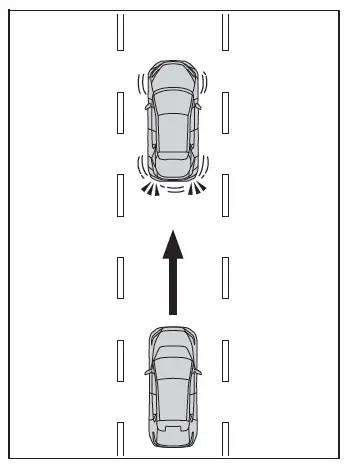
Toyota C-HR. Secondary Collision Brake (Rear Impacts while Stopped)

■Operating conditions of Secondary Collision Brake (Rear Impacts while Stopped)

When the following conditions are met, the Secondary Collision Brake (Rear Impacts while Stopped) will operate:

  • The power switch is in ON.
  • The shift position is in a position other than R.*
  • The turn signal lever is not being operated.
  • Approximately 7 or more minutes have elapsed since the system was operated.
  • The relative speed between your vehicle and the following vehicle is between approximately 30 and 100 km/h.
  • The vehicle speed is approximately 0 km/h.

*: When the N shift position is selected, the system is operational when none of the brake pedal, parking brake, or brake hold system are operated.

■The Secondary Collision Brake (Rear Impacts while Stopped) will detect a vehicle when

The Secondary Collision Brake (Rear Impacts while Stopped) detects the following vehicle driving in the same lane within the detection range, when it determines that the possibility of a rear-end collision with it is very high.

■Situations in which the Secondary Collision Brake (Rear Impacts while Stopped) cannot detect vehicles

The Secondary Collision Brake (Rear Impacts while Stopped) cannot detect the following vehicles and other objects:

  • Small motorcycles, bicycles, pedestrians, etc.*
  • Guardrails, walls, signs, parked vehicles and similar stationary objects*
  • Vehicles traveling in the opposite direction
  • A vehicle in an adjacent lane*

*: Depending on the conditions, detection of a vehicle and/or object may occur.

■Situations in which the Secondary Collision Brake (Rear Impacts while Stopped) may not operate properly

  • In the following situations, the system may not detect a following vehicle properly:
    • When the sensor is misaligned due to a strong impact to the sensor or its surrounding area
    • When mud, snow, ice, a sticker, etc. is covering the sensor or surrounding area on the rear bumper
    • When driving on a road surface that is wet with standing water during bad weather, such as heavy rain, snow, or fog
    • When driving up and down consecutive steep inclines, such as hills, dips in the road, etc.
    • When towing with the vehicle
    • When a following vehicle approaches immediately after your vehicle is stopped
    • When the following vehicle is not approaching from straight behind your vehicle
    • When the following vehicle is approaching from an angle
    • If a vehicle suddenly cuts behind your vehicle
    • When the following vehicle is surrounded by other vehicles
    • When there is a static object, such as a guardrail or wall, around a following vehicle
    • When the height of a following vehicle is too much different from that of your vehicle
    • When an accessory (such as a bicycle carrier) is installed to the rear of the vehicle
  • Especially in situations such as the following, the system may operate even though there is no possibility of a collision:
    • When the sensor is misaligned due to a strong impact to the sensor or its surrounding area
    • When towing with the vehicle
    • When your vehicle is stopped to make a turn at an intersection, etc. and a vehicle passes your vehicle from straight behind
    • When the vehicle is stopped at a roadside, etc. and another vehicle passes right next to your vehicle
    • When a following vehicle closely approaches your vehicle before overtaking
    • When a following vehicle suddenly approaches close to your vehicle
    • When your vehicle is surrounded by other vehicles
    • When there is a static object, such as a guardrail or wall, around a following vehicle
    • When a following vehicle approaches immediately before stopping or immediately after starting off
    • When braked on a slippery road, etc., locking your tires, and a following vehicle approaches
    • When the vehicle is washed in a car wash machine