SRS airbags
The SRS airbags deploy when the vehicle is subjected to certain types of severe impact that may cause significant injury to the occupants. The airbags work together with the seat belts to help reduce the risk of death or serious injury.
SRS airbag system
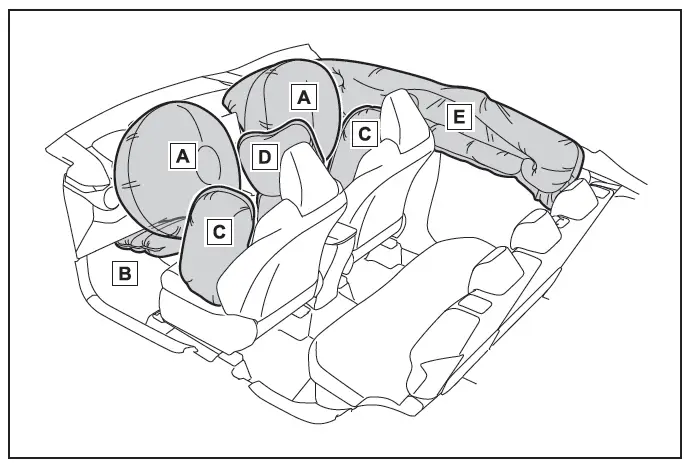
- SRS driver airbag/front passenger airbag Help reduce impact to the head and chest of the driver and front passenger
- SRS knee airbag Help reduce impact to the driver seat
- SRS side airbags Help reduce impact to the chest of the occupants of the front seats
- SRS front center airbags Help reduce impact to the head and neck of the occupants of the front seats
- SRS curtain shield airbags Help reduce impact to the heads of the occupants of the front and rear outer seats
The main SRS airbag system components are shown above. The SRS airbag system is controlled by the airbag sensor assembly. As the airbags deploy, a chemical reaction in the inflators quickly fills the airbags with nontoxic gas to help restrain the motion of the occupants.
■If the SRS airbags deploy (inflate)
- Slight abrasions, burns, bruising, etc., may be sustained from SRS airbags, due to the extremely high speed of deployment (inflation) by hot gases.
- A loud noise and white powder will be emitted.
- Parts of the airbag module (steering wheel hub, airbag cover and inflator) as well as the parts around the airbags may be hot for several minutes.
The airbag itself may also be hot.
- The windshield may crack.
- The hybrid system will be stopped and fuel supply to the engine will be stopped.
- The brakes and stop lights will be controlled automatically.
- The interior lights will turn on automatically.
- The emergency flashers will turn on automatically.
- Fuel supply to the engine will be stopped.
- Vehicles with eCall: For eCall subscribers, if any of the following situations occur, the system is designed to send an emergency call to the eCall control center, notifying them of the vehicle's location (without needing to push the "SOS" button) and an agent will attempt to speak with the occupants to ascertain the level of emergency and assistance required. If the occupants are unable to communicate, the agent automatically treats the call as an emergency and helps to dispatch the necessary emergency services.
- When an SRS airbag has been deployed
- When a seat belt pretensioner has operated
- When the vehicle has been involved in a severe rear-end collision
■The SRS airbags deploy in a frontal impact when
- The following SRS airbags will deploy in the event of an impact that exceeds a threshold level (level of force corresponding to an approximately 20 - 30 km/h [12 - 18 mph] frontal collision with a fixed wall that does not move or deform):
- SRS front airbags
- SRS knee airbag
- The threshold level at which the SRS airbags will deploy will be higher than normal in the following situations:
- When the vehicle collides with an object, such as a parked vehicle or sign pole, which moves or deforms on impact
- If the vehicle is involved in an under-ride collision, such as a collision in which the front of the vehicle "under-rides", or goes under, the bed of a truck
- Depending on the type of collision, only the following may deploy:
- Seat belt pretensioners
- SRS knee airbags
- The SRS airbags for the front passenger's seat will not deploy if there is no passenger in the front passenger seat. However, the SRS airbags for the front passenger's seat may deploy, even if the seat is unoccupied, if luggage is put on the seat.
- In the event of an especially severe frontal collision, the left and right SRS curtain shield airbags may also deploy.
■The SRS airbags deploy in a side impact when
- The following SRS airbags will deploy in the event of an impact that exceeds the set threshold level (level of force corresponding to the impact force produced by an approximately 1500 kg [3300 lb.] vehicle colliding with the passenger compartment at a perpendicular angle at an approximate speed of 20 - 30 km/h [12 - 18 mph] ):
- SRS side airbags
- SRS curtain shield airbags
- SRS front center airbags
- In the event of a side collision, regardless of the impacted side, both the left and right SRS curtain shield airbags will deploy.
■The SRS airbags deploy in an underside impact when
- The following airbags may deploy if the underside of the vehicle collides with a hard object:
- SRS front airbags
- SRS knee airbag
- SRS side airbags
- SRS curtain shield airbags
- SRS front center airbags

■The SRS airbags will not deploy when
- The following SRS airbags will not normally deploy in side or rear collisions, vehicle rollovers, or low speed frontal collisions. However, if such a collision causes sufficient sudden deceleration, the SRS airbags may deploy.
- SRS front airbags
- SRS knee airbag
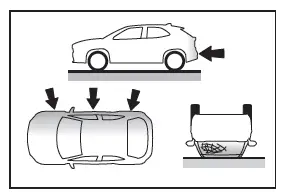
- The following SRS airbags may not deploy if the vehicle is collided with at a certain angle or in a side collision where an area of the vehicle other than the passenger compartment is collided with:
- SRS side airbags
- SRS curtain shield airbags
- SRS front center airbags
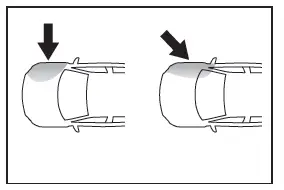
- The following SRS airbags will not normally deploy in front or rear collisions, vehicle rollovers, or low speed side collisions:
- SRS side airbags
- SRS front center airbags
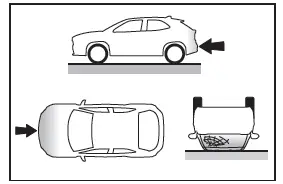
- The following SRS airbags will not normally deploy in rear collisions, vehicle rollovers, or low speed front or side collisions:
- SRS curtain shield airbags
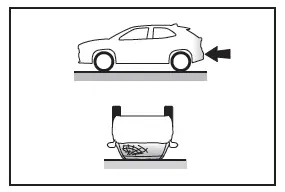
■When to contact any authorized Toyota retailer or Toyota authorized repairer, or any reliable repairer
In the following situations, the vehicle will require inspection and/or repair.
Contact any authorized Toyota retailer or Toyota authorized repairer, or any reliable repairer as soon as possible.
- When any of the SRS airbags have been deployed
- When the front of the vehicle is damaged or deformed, or was involved in a collision that was not severe enough to cause any of the following SRS airbags to deploy:
- SRS front airbags
- SRS knee airbag

- When a door or its surrounding area is damaged, deformed or has a hole made in it, or was involved in a collision that was not severe enough to cause any of the following SRS airbags to deploy:
- SRS side airbags
- SRS curtain shield airbags
- SRS front center airbags

- When the pad section of the steering wheel, the dashboard near the front passenger SRS airbag or the lower side of the instrument panel is scratched, cracked, or otherwise damaged.
- When the surface of a seat with an SRS side airbag or SRS front center airbag is scratched, cracked, or otherwise damaged.
- When the part of a front pillar, rear pillar or roof side rail garnish (padding) which covers a SRS curtain shield airbag is scratched, cracked, or otherwise damaged.
WARNING
■SRS airbag precautions
Observe the following precautions.
Failure to do so may result in death or serious injury.
- The driver and all passengers must wear their seat belts correctly.
The SRS airbags are supplemental devices to be used with the seat belts.
- The SRS driver airbag deploys with considerable force, and can cause death or serious injury, especially if the driver is very close to the airbag.
Since the risk zone for the driver's airbag is the first 50 - 75 mm (2 - 3 in.) of inflation, placing yourself 250 mm (10 in.) from your driver airbag provides you with a clear margin of safety. This distance is measured from the center of the steering wheel to your breastbone.
If your current driving position places you less than 250 mm (10 in.) away from the driver airbag, you can change your driving position in several ways:
- Move your seat to the rear as far as possible while still being able to reach the pedals comfortably.
- Slightly recline the seatback.
Although vehicle designs vary, many drivers can achieve the 250 mm (11 in.) distance, even with the driver seat all the way forward, simply by reclining the seatback somewhat.
If reclining the seatback makes it hard to see the road, raise yourself by using a firm, non-slippery cushion, or raise the seat if your vehicle has that feature.
- If your steering wheel is adjustable, tilt it downward. This points the airbag toward your chest instead of your head and neck.
The seat should be adjusted as recommended above, while still being able to control the vehicle with the pedals and steering wheel, and maintaining your view of the instrument panel controls.
- The SRS front passenger airbag deploys with considerable force, and can cause death or serious injury, especially if the front passenger is very close to the airbag. The front passenger seat should be positioned as far possible from the airbag with the seatback adjusted so that the passenger is sat upright.
- Improperly seated and/or restrained infants and children can be killed or seriously injured by a deploying airbag.
An infant or child who is too small to use a seat belt should be properly secured using a child restraint system. Toyota strongly recommends that all infants and children be placed in the rear seats of the vehicle and properly restrained. The rear seats are safer for infants and children than the front passenger seat.
- Do not sit on the edge of the seat or lean against the dashboard.
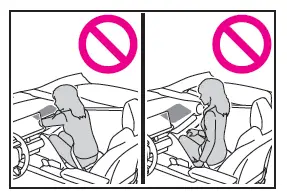
- Front seat occupants should never hold items on their lap.
- Do not allow a child to stand in front of the SRS front passenger airbag or sit on the lap of a front passenger.

- Do not lean against the door, roof side rail, or front, side, or rear pillar.
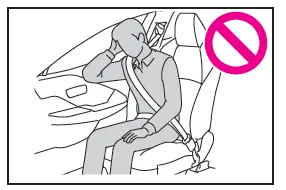
- Do not allow anyone to kneel on a seat toward the door or put their head or hands outside the vehicle.

- Do not attach anything to or lean anything against areas such as the dashboard, steering wheel pad and lower portion of the instrument panel.

- Do not attach anything to areas such as the doors, windshield, side windows, front or rear pillars, roof side rails and assist grips. (With the exception of the speed limit label)
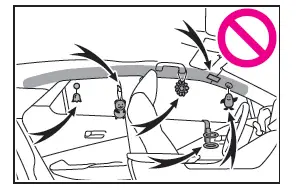
- Do not hang coat hangers or other hard objects on the coat hooks.
These items could become projectiles if the SRS curtain shield airbags deploy, possibly leading to death or serious injury.
- If a vinyl cover is attached to the area where the SRS knee airbag deploys, be sure to remove it.
- Do not use seat accessories which cover the parts from which the SRS airbags deploy, as they may interfere with inflation of the SRS airbags.
Such accessories may prevent the SRS airbags from deploying correctly, may disable the system or cause the SRS airbags to inflate unintentionally, possibly resulting in death or serious injury.
- Do not strike or apply significant force to the SRS airbag system components, front doors or their surrounding area.
Doing so may cause the SRS airbags to malfunction.
- Do not touch any components of the SRS airbags immediately after the SRS airbags have deployed (inflated) as they may be hot.
- If breathing becomes difficult after the SRS airbags have deployed, open a door or window to allow fresh air in, or leave the vehicle if it is safe to do so. Wash off any residue as soon as possible to prevent skin irritation.
- If a part where an SRS airbag is stored is damaged or cracked, have it replaced by any authorized Toyota retailer or Toyota authorized repairer, or any reliable repairer.
■Modification and disposal of SRS airbag system components
Do not dispose of your vehicle or perform any of the following modifications without consulting any authorized Toyota retailer or Toyota authorized repairer, or any reliable repairer. The SRS airbags may malfunction or deploy unintentionally, possibly leading to death or serious injury.
- Removal, installation, disassembly or repair of the SRS airbags
- Repair, removal or modification of the following parts or their surrounding
- Steering wheel
- Instrument panel
- Dashboard
- Seats
- Seat upholstery
- Front pillars
- Side pillars
- Rear pillars
- Roof side rails
- Front door panels
- Front door trim
- Front door speakers
- Modifications to the front door panels (such as making holes in them)
- Repair or modification of the following parts or their surrounding
- Front fender
- Front bumper
- Sides of the vehicle interior
- Installation of the following parts or accessories
- Bull bars or kangaroo bars
- Snow plows
- Winches
- Modifications to the vehicle's suspension
- Installation of electronic devices such as mobile two-way radios (RF-transmitter) and CD players