Cylinder Block
* If the cooling passage plugs sink into the cylinder block passage, they usually cannot be removed.
Cleaning
PROCEDURE
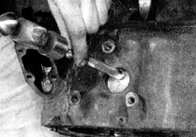
1. Using light hammer taps on the sharp edge of a center punch, drive the edges of the cylinder block plugs inward so that the plugs rotate in their bores.
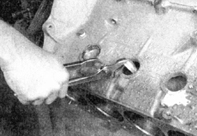
2. Then remove the plugs from the holes by prying them out with pliers.
3. Using a scraper, remove all gasket material residue from the cylinder block, taking care not to damage the mating surfaces.
4. Remove the main bearing caps and take the bearings out of the cylinder block and the caps. Mark the cylinder number near which each removed main bearing was installed, and mark whether it was removed from the bearing cap or from the cylinder block bearing bore. Place the bearings separately from each other.
5. Unscrew and remove all threaded plugs from the cylinder block passages. The plugs are practically impossible to remove, so drill them out and re-tap the threads. Replace all plugs during engine assembly.
6. If the engine is heavily contaminated, take the block to an auto service workshop for cleaning with a high-pressure steam jet or in a hot tank.
7. After the cylinder block is cleaned in the workshop, additionally clean all oil passages and holes. Brushes for cleaning passages and holes are available at almost all auto parts stores. Flush the internal passages with warm water until the water runs clean, dry the block thoroughly, and lubricate the machined surfaces with spindle oil to prevent corrosion. If compressed air is available, blow out the block and internal passages to speed up drying.
8. If the block is only slightly dirty, washing with warm water and detergent with a stiff brush is sufficient. Do not spare time and perform this work carefully. Regardless of the cleaning method, very carefully clean the oil passages and holes, dry the block, and lubricate the treated surfaces with spindle oil.

9. Chase the threaded holes in the block with a tap to ensure correct torque readings during assembly. Chasing with a tap removes dirt, corrosion and sealant residue from the threaded holes, and restores damaged threads.
10. If possible, blow out the holes with compressed air to remove debris left by the tap. Now is the time to clean the threads of the cylinder head bolts and the main bearing cap bolts.
11. Reinstall the main bearing caps and tighten the bolts by hand.
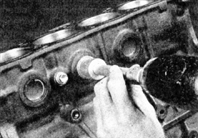
12. Install new plugs into the block after applying sealant to them. A special tool is required for installing the plugs, but this operation can be performed with the same quality by tapping a mandrel with a hammer, the diameter of which matches the plug hole. A 1/2 inch socket with an extension is suitable for this purpose.
13. Make sure the plugs are seated correctly and not cocked. Otherwise leaks are possible.
14. Coat the oil passage plugs with non-hardening sealant and screw them into the cylinder block holes. Make sure the plugs are tightened securely.
15. If engine assembly will not be carried out at this time, cover the cylinder block with a polyethylene cover to protect it from contamination.
Inspection
PROCEDURE
1. Before inspection, thoroughly clean the cylinder block.
2. Visually check the block for cracks and signs of corrosion. Check the condition of the threads and, if necessary, repair stripped threads. It is highly recommended to check the cylinder block for internal defects, for which the block must be taken to an auto service workshop with the appropriate equipment. If the engine has frequently overheated, or the coolant level has dropped due to loss of coolant, this check must be performed. If defects are found, repair or replace the block.
3. Check the cylinder bores for chips and scoring.
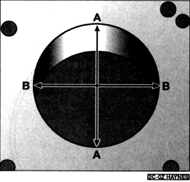
4. Check the cylinder bores for out-of-round and taper. Measure the inside diameter of the cylinder in directions parallel and perpendicular to the engine axis. Cylinder out-of-round is determined as the difference between the diameters measured in directions A and B. Cylinder taper is determined as the difference between the diameters measured in directions A and B at the upper and lower planes.
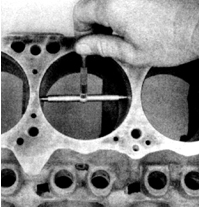
5. The ability to correctly "feel" the position of the bore gauge develops gradually. Therefore, take measurements slowly and recheck the result until you are sure the diameter is measured accurately.
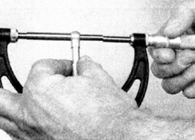
6. After setting the bore gauge against the cylinder walls, measure the length of the set bore gauge with a micrometer. This length equals the measured inside diameter.
7. Measure the cylinder inside diameter at the top (just below the ridge), in the middle, and at the bottom, parallel to the crankshaft axis.
8. Then take measurements at the same levels, but in the direction perpendicular to the crankshaft axis.
9. Cylinder taper is determined as the difference between the diameters at the upper and lower planes. Cylinder out-of-round is determined as the difference between the diameters measured perpendicular and parallel to the crankshaft axis. Compare the results with the specified values.
10. If the cylinder walls have heavy scoring or scratches, or the out-of-round or taper exceeds the specified limits, the block must be taken to a workshop for boring and honing. After the block is restored, pistons and rings of repair sizes will be required.

11. Using a feeler gauge and straightedge, check the distortion of the cylinder block and cylinder head mating surfaces. If the deviation from flatness exceeds the specification, the block must be resurfaced at an auto service workshop.
12. If the cylinder condition is acceptable and cylinder wear and piston-to-cylinder clearance do not exceed the specified limits, boring is not required. All that remains is to hone the cylinders (see subsection 3.1.2.12).
Test yourself
A quick Toyota Corolla quiz: every answer comes with an explanation and a link to the manual page.