Cylinder Honing
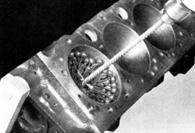
Bottle-brush type honing tool
Persons who have never performed cylinder honing are advised to use a flex-hone type tool.
Before engine assembly, hone the cylinders to ensure that the piston rings seal tightly against the cylinder walls and that the combustion chambers are sealed.
Two types of tools are commonly used for honing cylinders: a flexible hone and a tool with spring-loaded grinding stone heads (the latter is the most widely used). Both tools give good results, but for an inexperienced home mechanic the flexible hone is better, as it is much easier to use. You will also need kerosene or honing oil, lint-free rags, and an electric drill. The electric drill must run at low speed with a constant rotation speed. A large drill for a 12–13 mm bit or a variable-speed drill with a 3/8 in (9–10 mm) chuck is suitable.
* If you do not have a honing tool, this operation can be performed at a workshop for a small fee.
PROCEDURE
1. Before honing, install the crankshaft main bearing caps (without bearing inserts) and tighten the bolts to the specified torque.
2. Clamp the hone in the electric drill, secure the grinding stone heads, and insert the hone into the first cylinder.

3. Thoroughly lubricate the cylinder surface with oil, start the electric drill, and move it up and down in the cylinder periodically. A pattern of fine lines (1) crossing at an angle of approximately 60° must form on the cylinder wall surface. Keep the cylinder surface well lubricated at all times. Do not remove excessive material; finish honing after the surface is finished.
* Some piston ring manufacturers recommend a slightly smaller crosshatch angle than 60°. Refer to the instructions supplied with the piston rings.
4. Do not remove the hone while it is rotating. After turning off the drill, continue moving the hone up and down until it stops completely, then compress the hone legs with the grinding stones and remove the hone from the cylinder. If the cylinder is honed with a flex hone, turn off the drill, then, rotating the hone in the normal rotation direction, remove it from the cylinder.
5. Wipe the cylinder clean of oil and repeat the operation on the remaining cylinders.
6. After honing is complete, use a fine file to chamfer the upper edge of each cylinder to prevent ring damage when installing the pistons into the cylinders. Be careful not to scratch the cylinder walls with the file.
7. Wash the entire cylinder block again with warm water and detergent to remove any residual abrasive material from honing.
* The cylinders are considered clean if a lint-free cloth moistened with engine oil shows no grayish traces. Be sure to clean the oil passages and holes with a brush and rinse them with running water.
8. After washing, dry the cylinder block and coat all machined surfaces with spindle oil to prevent corrosion. Store the cylinder block under a plastic cover until engine assembly begins.
Test yourself
A quick Toyota Corolla quiz: every answer comes with an explanation and a link to the manual page.