GENERAL INFORMATION
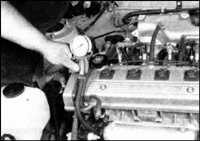
Checking oil pressure using a pressure gauge installed in place of the oil pressure switch
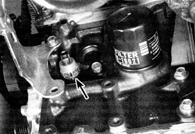
Oil pressure switch
The oil pressure switch (indicated by arrow) is located at the front of the cylinder block, next to the oil filter.
This subsection describes in detail the procedures for removing the engine from the vehicle and overhauling the cylinder head, cylinder block/crankcase, crankshaft, and other engine components.
Recommendations are given for preparing and organizing overhaul work and purchasing spare parts. Removal, inspection, repair, and installation procedures for engine assemblies and components are described in detail.
Starting with the next subsection, the description assumes the engine has been removed from the vehicle. Repair procedures performed without removing the engine from the vehicle are described in Subsection 3.1.1. Removal and installation of external engine assemblies and components required for overhaul are described in Subsection 3.1.2.6.
At the beginning of the section, all specifications required for inspection and overhaul are given, the procedures for which are described below.
Additional specifications are given in Subsection 3.1.1.1.
Engine Overhaul - General Notes
It is not always easy to decide whether a complete engine overhaul is advisable, as this must be based on a number of objective indicators.
High mileage is not by itself sufficient reason for an overhaul; on the other hand, low mileage does not rule out the need for one. The most important indicator is most likely the timeliness of routine engine maintenance. With timely oil and filter changes and performance of all other required maintenance, the engine will give reliable service for many thousands of kilometers. Conversely, insufficient or untimely maintenance may cause a sharp reduction in engine service life.
Increased oil consumption indicates wear of the piston rings, valve guides, and valve stem seals. Make sure that leaks are not the cause of increased oil consumption before concluding that the piston rings and valve guides are unserviceable. To determine the probable cause of the malfunction, measure the compression in the engine cylinders (see Subsection 3.1.2.3).
Also perform a vacuum gauge test and determine the nature of the gauge readings (see Subsection 3.1.2.2).
Check oil pressure with a pressure gauge installed in place of the oil pressure switch (see figure Checking oil pressure using a pressure gauge installed in place of the oil pressure switch) and compare the result with the specified value. If oil pressure is low, the cause may be wear of the main and connecting rod bearings or oil pump components.
Loss of power, hesitation, detonation or metallic knocking, excessive valvetrain noise, and increased fuel consumption indicate the need for an engine overhaul, especially if several of these symptoms of abnormal operation occur at the same time. If all adjustments do not improve operation, the only remedy for abnormal engine operation is an overhaul. An overhaul consists of restoring engine components to the condition specified for a new engine. During an overhaul, pistons and piston rings are replaced, and cylinders are bored or honed. After cylinder repair, which is performed at a specialized workshop, oversize pistons must be installed. Connecting rod and main bearing shells of the crankshaft, as well as camshaft bearing caps, are also subject to replacement; if necessary, crankshaft journals should be ground to restore normal clearances with the connecting rod and main bearing shells. As a rule, valves are also subject to repair, since their condition at the time of overhaul is usually not fully satisfactory. During engine overhaul, components such as the starter, alternator, and ignition distributor are also repaired. As a result, the overhauled engine should have the qualities of a new unit and withstand significant mileage without failure.
* During an overhaul, important cooling system components such as hoses, drive belts, thermostat, and coolant pump must be replaced. The radiator must be checked for leaks and cleanliness of internal passages (see Subsection 4.5). If you have purchased a remanufactured engine or an incomplete cylinder block, some suppliers do not guarantee operation of these assemblies unless the radiator is thoroughly flushed. During engine overhaul, it is also recommended to replace the oil pump.
Before starting an engine overhaul, read the description of the relevant procedures to get an understanding of the scope of work and its requirements. If all standards and procedures are followed, and all necessary tools and equipment are available, the overhaul is not difficult, but it requires a significant amount of time. Allow at least two weeks, especially if parts must be repaired or restored at a specialized workshop. Check the availability of spare parts and obtain the necessary special tools and equipment in advance. Almost all work can be performed with a standard set of tools, although precision measuring instruments will be required to inspect and determine the serviceability of certain parts. Parts condition is often checked at specialized workshops, which also provide recommendations on replacing or restoring particular parts.
* Consult an automotive repair workshop only after the engine has been completely disassembled and the condition of all parts has been inspected, especially the cylinder block, so that it can be determined which maintenance and repair operations will be performed at the workshop.
Since the condition of the cylinder block determines whether it should be repaired or a new (or remanufactured) cylinder block should be purchased, spare parts should be bought or machining of related parts should be performed only after a thorough inspection of its technical condition. As a rule, the true cost of a repair is time: do not pay for installing worn or restored parts. In conclusion, assemble all units with great care in a clean area to prevent further failures of the repaired engine and to ensure its reliable operation.
Test yourself
A quick Toyota Corolla quiz: every answer comes with an explanation and a link to the manual page.