Engine Diagnosis Using a Vacuum Gauge
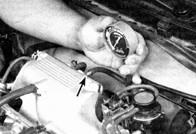
Connecting the vacuum gauge to the unused port on the intake manifold
The unused port is indicated by the arrow.
Measuring vacuum is a reliable and relatively inexpensive method of engine diagnosis. Vacuum gauge readings can give information on the condition of the piston group, the sealing of the cylinder head gasket and the intake and exhaust manifold gaskets, the correct adjustment of the fuel system and exhaust emission system, exhaust gas flow capacity, the condition of the valves (sticking or burnt valves) and valve springs, and can also check the correct ignition timing and valve timing while the engine is running.
Unfortunately, vacuum gauge readings are difficult to interpret and analysis results may be erroneous, so vacuum diagnosis should be combined with other methods.
The main factors used to analyze vacuum gauge readings and draw the most accurate conclusions about engine condition are the absolute reading of the gauge and the movement of the gauge needle (dynamics of the reading). The scale of most vacuum gauges is graduated in mm Hg. As vacuum increases (and pressure decreases accordingly), the gauge reading increases. For every 300 m above sea level, the absolute readings of the vacuum gauge will differ by approximately 25 mm Hg.
Connect the vacuum gauge directly to the intake manifold (see figure Connecting the vacuum gauge to the unused port on the intake manifold), but not to other openings where vacuum is created that are separated from the manifold by a passage of a certain length (for example, the openings in front of the throttle valve).
Before starting the test, fully warm up the engine. Chock the wheels and apply the parking brake. With the shift lever in Neutral (or in Park on vehicles with an automatic transmission), start the engine and let it idle.
* Before starting the engine, carefully check the condition of the fan blades (for damage or cracks). While the engine is running, do not bring your hands too close to the fan, keep the tester at a safe distance from the fan, and do not stand in line with the rotating fan blades.
Check the vacuum gauge reading. On a healthy engine, the vacuum gauge should indicate 430–560 mm Hg, and the needle should be nearly steady.
The following describes the vacuum gauge reading patterns and how to determine engine condition from them.
A vacuum reading that is too low usually indicates a leak at the intake manifold-to-throttle body gasket, a vacuum hose leak, late ignition timing, or incorrect valve opening and closing timing. Before removing the timing belt covers and checking the timing mark alignment, check ignition timing with a timing light and eliminate all other possible causes using the test procedures described in this Section.
If the vacuum reading is 75–200 mm Hg below normal and unsteady (needle fluctuates), this indicates a leak in the intake manifold inlet gasket or a faulty injector.
If the needle regularly deflects 50–100 mm Hg, the cause is valve leakage. To confirm this, check cylinder compression.
If the needle deflects irregularly toward low readings, or flutters while showing low vacuum, the probable cause is increased valve drag or misfiring cylinders. Check cylinder compression and inspect the spark plugs.
If, at idle, the needle rapidly fluctuates within a range of 100 mm Hg and the engine emits smoke from the exhaust, the valve guides are worn. To verify this conclusion, perform a combustion chamber leak test (air pressure test). If the needle fluctuates rapidly and engine speed increases at the same time, check the intake manifold gasket for leaks and the valve spring tension. Such readings may also be caused by burned valves and misfiring cylinders (ignition misfire).
Slight needle fluctuation (within 20–30 mm Hg in both directions) indicates unstable ignition operation. Check all specified settings and adjustments, and if necessary connect an ignition system analyzer to the engine. With large needle fluctuations, check cylinder compression or perform a leak test, as the cause may be a non-operating cylinder or a leaking cylinder head gasket. If the gauge reading changes slowly over a wide range, check the crankcase ventilation system hoses for blockage, verify the fuel mixture adjustment, and check the throttle body or intake manifold gaskets for leaks.
Quickly open the throttle, and when engine speed reaches 2500 rpm, release the throttle. The throttle should return to the idle position slowly. The vacuum gauge reading should drop almost to zero, then rise and exceed the steady idle reference reading by approximately 125 mm Hg, after which vacuum should return to its previous level. If vacuum recovers slowly and the reading does not exceed the reference value when the throttle is opened quickly, piston rings may be worn. If vacuum recovers extremely slowly, check the exhaust system for restriction (typically the muffler or catalytic converter). The simplest way to check this is to disconnect the exhaust system in front of the suspect section and repeat the test.
Test yourself
A quick Toyota Corolla quiz: every answer comes with an explanation and a link to the manual page.