Wheel Alignment Adjustment
These illustrations are provided for a better understanding of the individual basic wheel alignment terms.
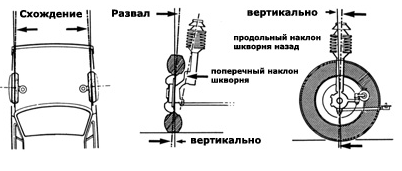
For reliable vehicle handling, the front wheels must be set at specific angles in the vertical and horizontal planes. To help you clearly understand the concept of "wheel alignment angles," we provide explanations of some terms:
Toe: on the Audi 80, the front wheels are positioned slightly closer together at the front than at the rear when at rest. This is referred to as "positive" toe. Friction between the tire and the road pushes the left wheel to the left and the right wheel to the right. This is offset by forces generated in the front-wheel drive that tend to pull the front wheels together at the front. When the vehicle enters a turn, positive toe changes to negative toe (toe-out). This occurs due to the trapezoidal arrangement of the steering linkage: the inner wheel in a turn steers at a greater angle than the outer wheel. This is necessary because during a turn the inner wheels travel a smaller radius than the outer wheels.
Camber: a slight inward tilt of the front wheels. On the Audi 80, the tops of the wheels in the wheel arch are positioned closer together than the bottoms. In specialist terminology, this is called "negative camber."
Camber and steering axis inclination: steering axis inclination is related to camber. Steering axis inclination is the slight tilt of the steering pivot axis, around which the entire strut assembly rotates when steering. The tops of both steering pivot axes are positioned closer together than the bottoms. Camber and steering axis inclination additionally help prevent wheel shimmy and make it easier to steer the wheels.
Caster: caster is the rearward tilt of the steering axis in the longitudinal direction of the vehicle. It also helps stabilize straight-line driving and prevent wheel vibration. In addition, caster causes the steering to return to center after turns.
Test yourself
A quick Audi 80 quiz: every answer comes with an explanation and a link to the manual page.