Checking Tires and Tire Pressure
The BMW 5 Series has tires and wheels of various sizes depending on model and equipment. In addition to wheel width, the wheel offset is also an important parameter. Offset is the distance between the longitudinal plane of symmetry of the wheel rim and the wheel mounting surface.
All wheels have so-called hump bead seats, which are a raised ring pressed into the rim that prevents the tubeless tire from slipping off the rim during sharp cornering.
When installing tires and/or wheels not specified in the vehicle documentation, the appropriate entries must be made in the documentation. As a rule, BMW approval is required for this.
Tires and wheels recommended for BMW vehicles are listed in the Specifications.
Regular tire inspection will help you avoid trouble caused by roadside stops due to a flat tire. In addition, such checks provide valuable information about possible steering and suspension problems before they develop into serious damage.
Tires are equipped with built-in tread wear indicators, which become visible when the tread depth wears down to 1.6 mm, at which point the tires are considered worn out. This value is the minimum permissible tread depth; in most cases it is recommended to replace tires when tread depth is 2 mm or less. Tread depth can also be determined with a simple and inexpensive tool known as a tread depth gauge.
Pay attention to any unusual tread wear. Tread defects such as cupping, bulges, flat spots, and more pronounced wear on one side indicate incorrect wheel alignment angles and/or wheel imbalance. If any of these defects are found, have them corrected at a tire service shop.
Carefully inspect the tire for cuts, punctures, and embedded nails or staples. Sometimes after a nail punctures a tire, it holds pressure for some time or loses pressure very slowly.
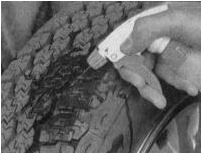
Raise the vehicle and spray soapy water onto the tread while slowly rotating the wheel - small bubbles will appear at the location of the puncture.
If a "slow leak" is suspected, first check the tightness of the valve core of the inflation valve. Then inspect the tread for embedded foreign objects or previously repaired punctures that have started to leak air again. If a puncture is suspected, confirm it by wetting the suspected area with soapy water. If there is a leak, the solution will bubble. If the puncture is not too large, the tire can usually be repaired at any tire service shop.
Carefully inspect the inner sidewall surfaces of the tires for signs of brake fluid leakage. If any are found, check the brake system immediately.
Maintaining correct tire pressure extends tire life, helps save fuel, and improves overall ride quality. A precision pressure gauge is required to check tire pressure.
* Always keep an accurate tire pressure gauge in your glove box. Gauges built into air hose nozzles at service stations are often inaccurate.
Always check tire pressure when tires are cold (i.e., before driving the vehicle). Checking pressure on warm or hot tires will result in readings that are too high due to thermal expansion of the tires. In this case, never release air, because after the tires cool down, the pressure will be below the specified value.
Check tire air pressure once a month and during scheduled maintenance. The tire pressure label is located on the driver's door pillar and in the Specifications.
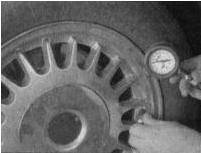
To extend tire life, check tire pressure at least once a week using an accurate gauge (do not forget the spare tire!)
Unscrew the protective cap from the inflation valve protruding from the wheel rim or hub cap, then press the gauge nozzle firmly onto the valve. Read the gauge and compare the reading with the value recommended in the Specifications. Be sure to reinstall the protective cap to prevent dirt and moisture from entering the valve mechanism. Check the pressure in all four tires and, if necessary, inflate them to the recommended pressure value.
Do not forget to maintain the required pressure in the spare tire as well.
Examples of Typical Tire Tread Wear
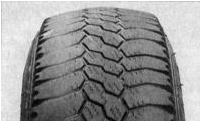
Shoulder Wear Insufficient pressure (wear on both sides)
Insufficient tire pressure causes the tire to overheat during driving due to excessive deflection, as a result of which the tread is not pressed against the road surface sufficiently. This leads to loss of grip with the road and excessive tread wear, not to mention the risk of tire failure as a result of overheating.
Check and adjust the tire pressure.
Incorrect wheel alignment (wear on one side)
Repair or replace suspension components.
Excessively sharp cornering
Reduce speed!
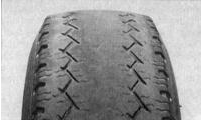
Center wear
Excessive tire pressure
Excessive tire pressure causes accelerated wear of the center of the tread, reduced grip with the road, harsher ride, and an increased risk of catastrophic tire failure.
Check and adjust the tire pressure.
If you had to inflate the tires to the pressure specified in the Specifications for carrying heavy loads, be sure to release the excess pressure when returning to normal driving conditions.
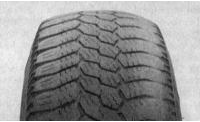
Uneven wear
Front tires may wear unevenly as a result of incorrect wheel alignment. The wheel alignment can be checked and adjusted at most tire service shops for a reasonable fee.
Incorrect camber or caster
Repair or replace suspension components.
Suspension defect
Repair or replace suspension components.
Wheels out of balance
Balance the wheels.
Incorrect front wheel toe-in
Check the front wheel alignment angles.
* Fraying of the tread pattern edges, which is a sign of wear, is best detected by touch.
Inspecting the Tire Valve
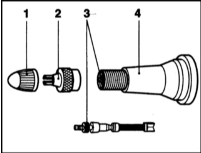
INSPECTION
1. Remove the cap from the valve.
2. Moisten the valve slightly with saliva. If an air bubble forms, turn the valve core (3) with the reversed cap wrench (2).
* Only the cap wrench (2) may be used to tighten the valve insert. Such cap wrenches can be purchased at gas stations. 1 - rubber protective cap, 4 - valve.
If a slow leak is suspected, tighten the valve core (3) with the reversed cap wrench (2).
3. Check the valve again. If an air bubble forms again or the valve does not tighten, replace it (service shop work).
4. Be sure to reinstall the protective cap.
Checking the Tire Tread and Wheel Mounting Security
INSPECTION
1. Tires on balanced wheels wear evenly over the entire surface when the specified air pressure is maintained, the wheels are installed correctly, and the shock absorbers function properly. It is difficult to state the service life of tires from particular manufacturers, as it depends on various factors, namely:
- Road surface
- Tire air pressure
- Driving style
- Atmospheric conditions
2. The main causes of faster tire wear are sporty driving style, sudden starts, and hard braking.
* Regulations permit tire tread wear down to a depth of 1.6 mm, i.e., the groove depth over the entire surface must be at least 1.6 mm. However, for safety reasons it is recommended to replace the tire when the minimum tread depth reaches 2 mm.

3. If the tread depth approaches the minimum permissible value, i.e., the wear indicators of 1.6 mm show no tread at many points around the tire circumference, the tires must be replaced. Tread wear indicators are located around the entire tire circumference. Refer to the accompanying illustration. Their location is marked on the sidewall by the letters "TWI" and the symbol "s". TWI - Tread Wear Indicator.
* M + S (winter) tires are effective on slush and snow if the tread depth is at least 4 mm.
The location of the wear indicators is marked on the sidewall by the letters "TWI" and the symbol "s". TWI - Tread Wear Indicator
* Check the tires for cuts. The depth of cuts can be determined with a small screwdriver. If cuts reach the carcass, water penetration may cause corrosion of the steel belt. As a result, the tire tread may separate from the carcass and the tire will fail. Therefore, if deep cuts are present, the tire must be replaced.
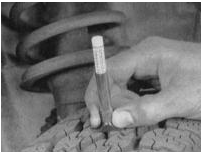
4. To determine tire wear, use a tread depth gauge. They are sold at auto accessory stores and service stations and cost very little.
5. Tighten the wheel bolts in a crosswise sequence to a torque of 100 N·m. Do not lubricate the bolts with oil or grease.
Test yourself
A quick BMW 1 quiz: every answer comes with an explanation and a link to the manual page.