Suspension and Steering Components Condition Inspection
* Steering and suspension components should be inspected regularly. Worn or damaged suspension and steering components can cause excessive and dangerous tire wear, deterioration of handling and steering performance, and increased fuel consumption.
For more information on suspension and steering system components, refer to the Suspension and Steering section.
Shock Absorber Inspection
PROCEDURE
1. Park the vehicle on a level surface, turn off the engine and apply the parking brake. Check the tire pressure.
2. Press down on one corner of the vehicle, then release it, observing the body movement. The body should stop moving and return to its normal position after one or two bounces.
3. If the vehicle continues to bounce or does not return to its normal position, a worn or weak shock absorber may be the cause.
4. Repeat the above procedure for each of the remaining three corners of the vehicle.
5. Raise the vehicle and support it securely on stands.
6. Inspect the shock absorbers for signs of hydraulic fluid leakage. A light film of fluid is not a cause for concern. If leakage is found, make sure the fluid is coming from the shock absorber and not from another source. If the leakage is from the shock absorber, replace the shock absorbers in pairs on the same axle (or all four).
7. Check the shock absorbers for secure mounting and damage. Inspect the upper mounts for damage and signs of wear. If any are found, replace the shock absorbers.
8. If shock absorber replacement is required, refer to the Suspension and Steering section for instructions. Always replace both components on the same axle; otherwise, vehicle safety may be compromised. If possible, replace all four components as a set.
Steering and Suspension System Condition Check
PROCEDURE
1. Inspect the steering system components for damage and deformation. Look for signs of fluid leakage, damaged gaskets, boots and fittings.
2. Clean the lower end of the steering knuckle. Ask an assistant to grasp the lower edge of the wheel and rock it while you observe the movement of the ball joints connecting the steering knuckle to the control arm. Inspect the ball joint boots for tears. If you detect play or torn or leaking boots, the ball joint(s) must be replaced.
3. Grasp each front wheel at the front and rear edges and try to turn it with the front edge inward and the rear edge outward to check for play in the steering linkage. If play is detected, check whether the steering gear mounting bolts and tie rod joints are loose. If the mounting bolts are loose, tighten them. If the tie rods are loose, worn joints may be the cause (first check that the nuts are tight). For additional information on the steering system and suspension, refer to the Suspension and Steering section.
Tie Rod End and Ball Joint Boot Inspection
PROCEDURE
1. Raise and support the front of the vehicle on stands.
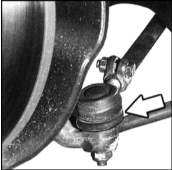
2. Inspect the protective boots on both the right and left sides. Look for traces of grease.
3. If the boot is damaged, replace the corresponding joint. Entry of dirt will cause the joint to fail.
Steering Wheel Free Play Check
PROCEDURE
1. Set the steering wheel to the center position.
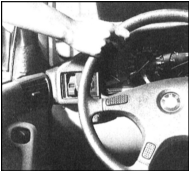
2. Through the open window, turn the steering wheel in both directions. Steering wheel free play (with the wheels stationary) measured at the outer rim must not exceed 25 mm.
3. If steering wheel free play is excessive, inspect the tie rods, steering gear and bearing clearances.
4. Move the tie rods firmly in both directions. There must be no play in the ball joints. If play is present, replace the joints or tie rods.
Test yourself
A quick BMW 1 quiz: every answer comes with an explanation and a link to the manual page.