Drive Belt Condition Inspection
Inspection
Drive belts (V-ribbed belts) are located at the front of the engine and play an important role in the operation of the vehicle and its individual components. Due to material properties and operating conditions, drive belts eventually wear out, so their condition should be checked periodically and belt tension adjusted to avoid serious engine damage.
The number of belts used on a particular vehicle depends on the components and systems installed. Drive belts are used to drive the alternator, power steering pump, water pump and air conditioning compressor. Depending on pulley layout, one belt may drive several components at once.
PROCEDURE
1. Turn off the engine, open the hood and locate the various drive belts at the front of the engine. Using your fingers (and a flashlight if necessary), run along the entire length of each belt, feeling for cracks and delamination. Also check for abrasion and glazed areas. Each belt must be inspected on both sides, which requires twisting the belt to check the back side.
2. Check belt tension by pressing firmly on the belt with your thumb and measuring the amount of deflection. Measure the deflection with a ruler. As a rule of thumb, if the distance between pulley centers is 180 to 280 mm, deflection should be 6 mm. If the distance between pulley centers is between 300 and 400 mm, deflection should be 13 mm.
3. Side wear: rib tip wear (B). A new belt has trapezoidal-shaped ribs.
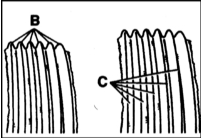
4. The tension side of the belt is visible at the base of the ribs. It is identified by lighter areas.
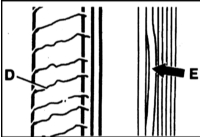
5. Transverse cracks (D) on the back side of the belt.
6. Separation of individual ribs (E).
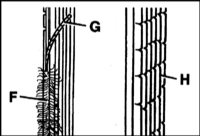
7. Fraying of the outer cords of the belt (F). Refer to the accompanying illustration.
8. Cord edge separation (G).
9. Transverse cracks (H) in many ribs.
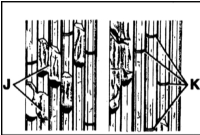
10. Broken ribs (J). Refer to the accompanying illustration.
11. Individual transverse rib breaks (K).
12. Dirt and stone buildup between the ribs.
13. Rubber deposits at the base of the ribs.
14. If one or more of the above defects are present, the belt must be replaced. Refer to Removal, Installation and Tensioning of V-Ribbed Belt.
15. Check the belt for aging by inspecting for cracks. Otherwise the belt requires no maintenance.
The V-ribbed belt is tensioned by an automatic tensioner. Belt tension checks are not required.
Test yourself
A quick BMW 1 quiz: every answer comes with an explanation and a link to the manual page.