Positive Crankcase Ventilation (PCV) System
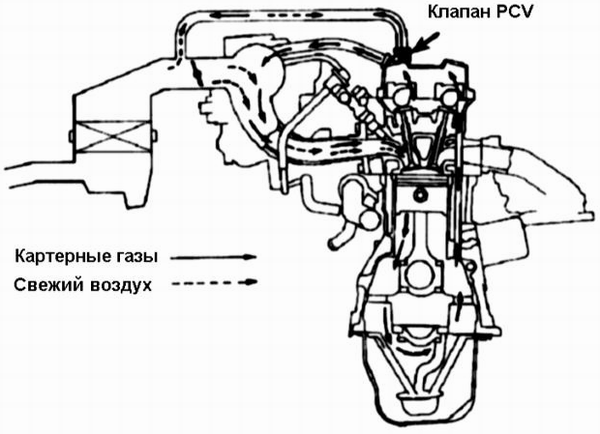
The PCV system (see accompanying illustration) reduces hydrocarbon emissions into the atmosphere by routing crankcase gases out of the engine. Crankcase ventilation works by drawing fresh air from the air cleaner through the crankcase, where it mixes with accumulated vapors and blow-by gases from the combustion chambers. The mixture then passes through the PCV valve into the intake manifold.
The main components of the system are the PCV valve, the purge filter, and the set of vacuum hoses that connect these parts to the engine.
To keep idle speed stable, the PCV valve closes the purge flow when intake manifold vacuum is high. If the engine is malfunctioning (for example, due to piston ring wear), the system routes excess crankcase gases back to the air cleaner through the ventilation tube.
Procedures for inspecting and replacing the PCV valve are described in the Inspection and Replacement of the Positive Crankcase Ventilation (PCV) Valve section.
Test yourself
A quick Honda Accord quiz: every answer comes with an explanation and a link to the manual page.