Knock Sensor Condition Check
Knock sensors respond to increased engine vibration, usually caused by detonation of the air-fuel mixture. Based on the information received from the sensor, the PCM adjusts ignition timing, trying to keep it at the maximum possible level that ensures sufficient engine output. The sensor generates an AC signal whose amplitude increases in proportion to the vibration level. To compensate for detonation, the PCM retards ignition timing when necessary.
TESTING
PROCEDURE
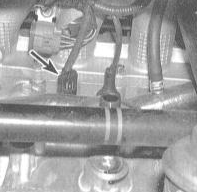
Disconnect the knock sensor electrical connector and drain the coolant from the engine (refer to Maintenance and Adjustments). Remove the knock sensor from the engine block. Reconnect the connector to the sensor. Sensors of this type are checked by monitoring voltage fluctuations on a voltmeter. Set the meter to the low AC voltage scale. Connect the negative meter lead to the sensor body and the positive lead to the terminal. Lightly tap the lower part of the sensor with a hammer to simulate vibration. If the voltmeter does not show voltage fluctuations, replace the sensor.
In principle, this check can also be performed without removing the sensor from the engine.
Test yourself
A quick Honda Accord quiz: every answer comes with an explanation and a link to the manual page.