Specifications, General Information
O2 Sensor Voltage, V
Open circuit 0.1 ÷ 0.2
Closed circuit 0.1 ÷ 0.9
Crankshaft Position/TDC Sensor Resistance (CKP/TDC), Ω 1850 ÷ 2450
Cylinder Position Sensor (CYP) Resistance, Ω 800 ÷ 1500
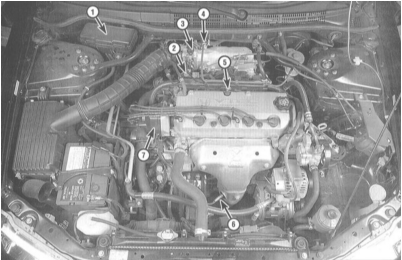
Engine Control/Emission Control Component Location in Engine Compartment, 4-Cylinder Models
1 — Electrical Load Detector (ELD) (part of the main fuse/relay box)
2 — Exhaust Gas Recirculation (EGR) Valve
3 — Manifold Absolute Pressure (MAP) Sensor
4 — Idle Air Control (IAC) Valve
5 — Positive Crankcase Ventilation (PCV) Valve
6 — Oxygen Sensor (O2 sensor)
7 — Cylinder Position (CYP) Sensor (part of the ignition distributor)

Engine Control/Emission Control Component Location in Engine Compartment, V6 Models
1 — Electrical Load Detector (ELD) (under the main fuse box)
2 — Positive Crankcase Ventilation (PCV) Valve
3 — Manifold Absolute Pressure (MAP) Sensor
4 — Throttle Position (TP) Sensor
5 — Exhaust Gas Recirculation (EGR) Valve
To reduce the emission of harmful substances into the atmosphere from exhaust gases resulting from fuel evaporation and incomplete combustion, and to maintain engine efficiency and reduce fuel consumption, the vehicles covered in this Manual are equipped with a number of special systems, collectively known as engine control and emission control systems.
The systems related to engine operation control and exhaust emission control include the following:
a) On-Board Diagnostics (OBD);
b) Programmed Fuel Injection (PGM-FI) Electronic Engine Control System;
c) Electrical Load Detector (ELD);
d) Exhaust Gas Recirculation (EGR) System;
e) Evaporative Emission Control (EVAP) System;
f) Positive Crankcase Ventilation (PCV) System;
g) Catalytic Converter.
All of the systems listed above are directly or indirectly related to the control of exhaust emissions.
The sections below provide general descriptions of how each system operates, as well as diagnostic inspection procedures and repair procedures (where repair is possible) for system components that are within the capability of an average do-it-yourself mechanic.
Before concluding that any emission control system has failed, carefully check the fuel and ignition systems (see the Fuel and Exhaust and Engine Electrical chapters). Diagnosis of some emission control components requires special, complex equipment and a certain level of skill, so it is advisable to have these checks performed by professional technicians at a dealer service station.
The above does not mean that servicing and repairing emission control components is difficult in practice. Keep in mind that one of the most common causes of failure is simply poor vacuum or electrical connections, so always check the condition of hose fittings and electrical connectors first. The vehicle owner can perform a number of checks and many routine maintenance procedures on most system components at home, using a standard set of adjustment and hand tools. Note: Keep in mind the additional federal warranty obligations that cover emission control and engine control components. Before performing any repair procedures on these system components, consult with a Honda dealer regarding the terms of these warranty obligations.
Observe all precautions specified in the following sections when servicing the electronic components of these systems. Note that the illustrations may not always exactly match the actual component locations on the vehicle. Such discrepancies arise from the continuous process of modification within the standard design of each model.

The Vehicle Emission Control Information (VECI) label is attached in the engine compartment. The label contains the necessary information on settings and checks of the controlled systems, taking into account all modifications made to the specific vehicle, as well as a vacuum hose routing diagram with identification of the various components. Before servicing the emission control and engine management systems, carefully review the VECI data.
Test yourself
A quick Honda Accord quiz: every answer comes with an explanation and a link to the manual page.