Catalytic Converter - General Information, Inspection and Replacement
To avoid voiding the warranty coverage for exhaust emission control system components, inspect and service the catalytic converter only at an authorized service facility.
General Information
The catalytic converter is a component of the exhaust emission control system. It is part of the exhaust system and reduces atmospheric emissions of harmful substances. The vehicles covered in this Manual use two types of catalytic converters. The conventional oxidation converter reduces hydrocarbon and carbon monoxide content in the exhaust gas. The three-way catalytic converter additionally reduces emissions of oxides of nitrogen (NOx).
INSPECTION
PROCEDURE
1. Diagnostic equipment for checking the condition of the catalytic converter is expensive and very complex to operate. If you suspect converter failure, drive the vehicle to a service station for inspection.
2. Each time the vehicle is raised off the ground for any reason, inspect the converter for signs of mechanical damage, leaks, and corrosion. Check the condition of the welds and the tightness of the flange bolts securing the converter to the exhaust system sections. A defective catalytic converter must be replaced.
3. Despite the reliability of the converter design, the probability of clogging is fairly high. The simplest way to check converter flow is a vacuum gauge test:
a) Connect a vacuum gauge to the intake manifold vacuum source (see Engine section);
b) Warm the engine to normal operating temperature, place the selector lever in “P” (AT models) or in neutral (MT models), and apply the parking brake;
c) Read the vacuum gauge at engine idle speed;
d) Quickly open the throttle almost fully, then release it immediately, allowing engine speed to return to idle. Read and record the vacuum gauge reading;
e) Repeat this test three more times, recording the result each time;
f) If the fourth reading is more than 2.54 mm Hg lower than the idle reading, there is a possibility of restricted flow in the converter or muffler.
Component Replacement
PROCEDURE
1. Before removing the catalytic converter flange fasteners, apply penetrating fluid to the threads.
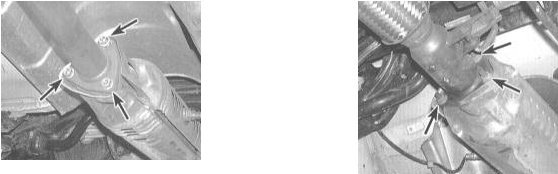
2. Remove the mounting nuts and lower the catalytic converter from under the vehicle.
3. Installation is the reverse of removal.
Test yourself
A quick Honda Accord quiz: every answer comes with an explanation and a link to the manual page.