Four-Wheel Drive (4WD) (minivan, van) (if equipped)
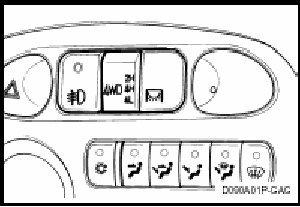
FOUR-WHEEL DRIVE (4WD) (minivan, van) (if equipped)
Engine power can be delivered to both the front and rear wheels for maximum traction. 4WD is useful on snowy, muddy, icy, hilly, or sandy terrain where good traction is required, or when your two-wheel drive loses traction on the road.
2H Transfer Case Switch Positions (rear-wheel drive)
For driving on normal roads and highways.
4H (four-wheel drive with high range)
For driving at normal speeds in deep snow, sand, or on rough roads.
The 4WD - (HI) indicator light will illuminate to remind you that you are in 4H mode.
4L (four-wheel drive with low range)
For climbing or descending steep slopes or driving on rough roads, such as muddy roads. Especially when increased drive power is required.
The (LO) indicator light will illuminate to remind you that you are in 4L mode.
 CAUTION:
Do not use 4WD on dry paved roads. Especially on dry highways, never select 4WD (4H or 4L).
Driving in four-wheel drive on dry paved roads for a long time increases fuel consumption, and may cause noise and premature tire wear. In addition, the temperature of the differential oil rises and drivetrain components may wear.
Transfer Case Switch Operation
When this transfer case switch is selected (4H, 4L), both axles of the vehicle are rigidly connected to each other. This improves traction.

Select the 4H mode at speeds below 60-70 km/h. It is not necessary to depress the clutch pedal (manual transmission) or move the selector lever to "N (Neutral)" (automatic transmission).
Perform this operation while driving in a straight line.

Select the 2H mode. This can be done at any speed, and it is not necessary to depress the clutch pedal (manual transmission) or move the selector lever to "N (Neutral)" (automatic transmission).
Perform this operation while driving in a straight line.
If the transfer case switch is moved to 2H while the vehicle is making a sharp turn or sudden maneuver, the 4H indicator light on the instrument cluster will go off. However, the vehicle will still be operating in 4H mode. This is normal.
When the vehicle returns to normal driving conditions, the 4WD system will automatically switch to 2H mode.

1. Stop the vehicle (0-3 km/h). 2. Depress the clutch pedal (manual transmission) or move the selector lever to "N (Neutral)" (automatic transmission).
3. Select the 4H or 4L mode.

1. Stop the vehicle (0-3 km/h). 2. Depress the clutch pedal (manual transmission) or move the selector lever to "N (Neutral)" (automatic transmission).
3. Select the 4L mode.

1. Stop the vehicle (0-3 km/h). 2. Depress the clutch pedal (manual transmission) or move the selector lever to "N (Neutral)" (automatic transmission).
3. Select the 2H mode.
Four-Wheel Drive Safety Precautions
• Your driving posture should be more upright and closer to the steering wheel than usual.
Adjust the seat so that you can steer and operate the pedals easily.
• Always fasten your seat belt.
• Drive carefully off-road and avoid dangerous areas.
• 4WD vehicles have higher ground clearance and a narrower track width, which provide improved off-road capability. Due to their special design characteristics, they have a higher center of gravity than standard vehicles.
The advantage of higher ground clearance is improved visibility of the road, which allows you to see potential problems in advance.
They are not designed to be driven through turns at the same speeds as conventional 2-wheel drive vehicles, just as sports cars with low suspension are not designed for off-road use. Avoid sharp turns or sudden maneuvers whenever possible. As with other vehicles of this type, improper driving may cause loss of control or rollover.
• Do not squeeze the inside of the steering wheel when driving off-road.
The steering wheel may kick back suddenly and injure your hands. When driving off-road, always hold the outside of the steering wheel firmly.
• In strong crosswinds, drive at a low speed. Because your vehicle has a high center of gravity, crosswinds affect vehicle stability. Lower speed provides better vehicle control.
• When driving in off-road conditions such as sand, mud, or water up to the wheel hub, maintenance procedures must be performed more frequently.
• Do not drive through water if the water level is above the bottom of the wheel hubs.
• Check the brakes immediately after leaving mud or water.
While driving slowly, apply the brake several times until the brake pedal feels normal.
• Driving in 4-wheel drive on dry paved roads or highways may cause severe binding when turning the steering wheel.
Driving on Dry Paved Roads and Highways
Select 2H (2WD) for driving on dry paved roads.
Never select 4H or 4L (4WD) on dry highways, especially.
Driving on Snowy or Icy Roads
Select 4H or 4L according to road conditions, then gradually depress the accelerator pedal for a smooth start.
Driving on Sand or Muddy Ground
Select 4H or 4L, then gradually depress the accelerator pedal for a smooth start. Keep accelerator pedal pressure as constant as possible and drive at low speed.
Driving Up a Steep Hill
Select 4L to maximize engine torque.
Driving Down a Steep Hill
Select 4L, use engine braking, and descend slowly.
Test yourself
A quick Hyundai H1 quiz: every answer comes with an explanation and a link to the manual page.