Engine and peripherals
Injection rail
In this manual: Engine and peripherals
~5min read
Essential equipment |
| diagnostic tool |
| "low torque" torque wrench |
Tightening torques |
|
| cover nut on rail | 2.1 daN.m |

Before any work on the injection system, use the diagnostic tool to check:
- that the fuel temperature is not high.
- that the injection rail is no longer under pressure,
- Always observe the safety and cleanliness instructions given in this document during every operation.
- Never loosen a high-pressure pipe connection while the engine is running.
- Use the special plug kit for the high-pressure injection circuit.
- Always replace any high-pressure pipe and high-pressure pipe clips that have been removed.
- Do not work on the injectors.
- Do not remove the injector filter.
- Always replace any injector that has been opened.
- Do not separate the pressure sensor from the rail.
REMOVAL
- Remove the engine covers.
- Disconnect the battery.
- Remove:
- the high-pressure rail-to-injector pipes (Diesel Injection chapter, High-Pressure Pipe: Replacement, page 13B-80).
- the injection rail mounting bolts,
- the injection rail.
INSTALLATION
CAUTION: Remove the protective caps only at the last moment.
CAUTION Always replace all high-pressure pipes that have been removed.
- Fit a new high-pressure rail onto the studs.
- Start the nuts by hand.
- Fit the pump-to-rail pipe before the rail-to-injector pipes.
- For refitting the high-pressure pipes (Diesel Injection chapter, High-Pressure Pipe: Replacement, page 13B-80).
- Refit in the reverse order of removal.
- Prime the diesel circuit using the priming pump.
- Tighten the union nut on the rail to torque (2.1 daN.m) using the "low torque" torque wrench.
Connect the battery; carry out the necessary re-learns (see Electrical Equipment chapter).
WARNINGCheck for diesel leaks:
- check the seal after the repair (Diesel Injection chapter, High-pressure pipe: Sealing check, page 13B-48),
- run the engine at idle until the radiator fan starts,
- rev the engine several times with no load,
- carry out a road test,
- switch off the ignition,
- check that no diesel is leaking.
F9Q
Essential special tools |
|
| Mot.1566 | High-pressure pump pipe removal tool |
Essential equipment |
| diagnostic tool |
| "low torque" torque wrench |
Tightening torques |
|
| fuel rail mounting bolts | 2.2 daN.m +/- 0.2 |
| high-pressure injection pipe nuts | 2.5 daN.m +/- 0.2 |
| pressure sensor | 3.5 daN.m +/- 0.2 |

Before any work on the injection system, use the diagnostic tool to check:
- that the injection rail is no longer under pressure,
- that the fuel temperature is not too high.
- Always observe the safety and cleanliness instructions given in this document during every operation.
- Never loosen a high-pressure pipe connection while the engine is running.
- Use the special plug kit for the high-pressure injection circuit.
- Always replace any high-pressure pipe and high-pressure pipe clips that have been removed.
- Do not work on the injectors.
- Do not remove the injector filter.
- Always replace any injector that has been opened.
REMOVAL
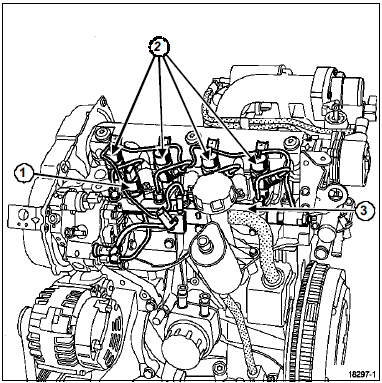
- Remove the air intake duct (see Mixture chapter).
- Disconnect the oil vapour breather hose.
- Move the oil vapour breather hose aside.
- Remove the engine covers.
- Disconnect:
- the battery,
- the pressure sensor (1),
- the injectors (2),
- the cylinder identification sensor.
- Remove the diesel return pipe.
- Loosen the high-pressure diesel pipes.
- Remove the high-pressure diesel pipes using tool (Mot.1566).
- Fit protective caps to the openings.
- Carefully remove the injection rail (3).
INSTALLATION
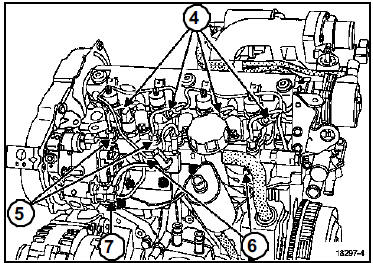
- Position the injection rail.
- Start the mounting bolts (the rail must be free to move) by hand.
- Fit all the new high-pressure pipes by hand:
- injector end,
- pump end,
- rail end.
- Tighten the injection rail mounting bolts to torque (2.2 daN.m +/- 0.2) (6) using the "low torque" torque wrench tool.
- Tighten the high-pressure injection pipe nuts to torque (2.5 daN.m +/- 0.2) using the "low torque" torque wrench tool:
- injector end (4),
- pump end (7),
- injection rail end (5).
- Tighten the pressure sensor to torque (3.5 daN.m +/- 0.2).
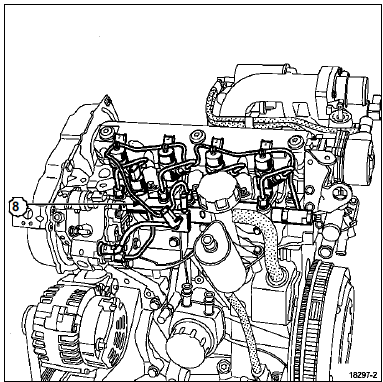
- Bleed the circuit using the priming bulb.
Connect the battery; carry out the necessary re-learns (see Electrical Equipment chapter).
WARNINGCheck for diesel leaks:
- run the engine at idle until the radiator fan starts,
- rev the engine several times with no load,
- carry out a road test,
- switch off the ignition,
- check that no diesel is leaking.
Test yourself
A quick Renault Megane quiz: every answer comes with an explanation and a link to the manual page.
Was this page helpful?