Injection strategy - Air conditioning
K9K
Air conditioning control is shared between several ECUs that communicate over the multiplexed network.
It is of the "cold loop" type.
The injection ECU is responsible for:
- managing the cooling demand according to the cabin controls and the circuit pressure value,
- determining the power absorbed by the compressor from the circuit pressure value,
- enabling control of the cooling fan according to vehicle speed and circuit pressure,
- enabling or disabling compressor clutch engagement.
When the air conditioning switch is pressed, the air conditioning control panel requests compressor clutch engagement permission.
The injection ECU enables or disables compressor clutch engagement, controls the cooling fan assembly via the protection and switching unit, and adopts a fast idle speed.
This speed is 900 rpm, depending on the power absorbed by the compressor.
The injection ECU enables operation of the air conditioning compressor and the cooling fan assembly (both powered by the protection and switching unit) depending on the following conditions:
- engine coolant temperature,
- vehicle speed,
- air conditioning.
The information used for the air conditioning function is transmitted via:
- pin A A4, multiplexed link "CAN HIGH",
- pin A A3, multiplexed link "CAN LOW".
The connections between the injection ECU and the refrigerant pressure sensor are:
- C C3 refrigerant pressure sensor signal,
- C C4 refrigerant pressure sensor supply,
- C G3 refrigerant pressure sensor earth.
The air conditioning compressor is of the "variable displacement" type.
I - AIR CONDITIONING COMPRESSOR ENGAGEMENT STRATEGY
In certain operating phases, the injection ECU prevents compressor operation.
1 - Engine start strategy
Air conditioning compressor operation is prevented for 1 second after the engine starts.
2 - Thermal protection strategy
The air conditioning compressor is not engaged if the engine temperature is above 115 °C, or above 110 °C at high speed, 4500 rpm for more than 10 seconds.
3 - Cooling fan assembly control strategy
At idle as well as while driving, with air conditioning selected, the low or high speed of the cooling fan assembly is activated depending on the refrigerant pressure and vehicle speed.
4 - Performance recovery
On a firm press (more than 75 % of travel) of the accelerator pedal, the compressor is disengaged for 5 seconds.
5 - Power recovery when moving off
To assist moving off, the air conditioning compressor is disengaged if the accelerator pedal position is greater than 30 % and the engine speed is below 1250 rpm.
6 - Anti-stall protection
The air conditioning compressor is disengaged if the engine speed is below 740 rpm.
7 - Timed overspeed protection strategy
The air conditioning compressor is disengaged if the engine speed is above 4500 rpm for more than 3 seconds.
Note: The period between two air conditioning compressor disengagements is always greater than 10 seconds.II - CABIN HEATER RESISTOR ENGAGEMENT STRATEGY
To reduce heating time, resistive air heating elements called "cabin heater resistors" are fitted into the cabin heating circuit.
The passenger compartment control unit determines whether the heater resistors must be switched on, based on the driver's request.
The engine management ECU determines:
- the number of heater resistors supplied (power control limitation), based on alternator load,
- the prohibition of heater resistor operation, based on engine speed, load and vehicle speed.
The heater resistors are supplied by the protection and switching unit.
When the heater resistors are requested, the fast idle speed becomes 900 rpm.
III - CABIN HEATER RESISTOR ACTIVATION STRATEGY
In certain operating phases, the engine management ECU prohibits operation of the cabin heater resistors.
1 - Engine start strategy
Operation of the cabin heater resistors is prohibited for 20 seconds after engine start.
2 - Performance recovery strategy under high load
Under high load at low engine speeds, operation of the heater resistors is interrupted.
Entry conditions:
- engine speed below 3000 rpm,
- and vehicle speed below 130 km/h.
Exit conditions:
- engine speed above 3500 rpm,
- and vehicle speed above 150 km/h.
3 - Performance recovery when starting on a slope
To assist hill starts, operation of the heater resistors is interrupted.
Entry conditions:
- engine speed below 900 rpm,
- and vehicle speed below 4 km/h,
- and gearbox in neutral.
Exit conditions:
- engine speed above 2500 rpm,
- or vehicle speed above 6 km/h,
- or gear engaged.
4 - Engine stall protection strategy
When engine speed drops below 760 rpm, operation of the cabin heater resistors is interrupted. When engine speed rises above 750 rpm, operation of the cabin heater resistors is allowed again.
Air conditioning control is shared between several ECUs that communicate over the multiplexed network.
When the air conditioning switch is pressed, the air conditioning control panel requests compressor clutch engagement permission.
The engine management ECU enables or disables engagement of the A/C compressor clutch and controls the cooling fan assembly via the protection and switching unit.
When the air conditioning function is selected, idle speed is not changed.
The information used for the air conditioning function is transmitted via:
- pin A A4, multiplexed link "CAN HIGH",
- pin A A3, multiplexed link "CAN LOW".
The compressor is of the variable displacement type.
I - AIR CONDITIONING COMPRESSOR ACTIVATION STRATEGY
In certain operating phases, the engine management ECU prohibits operation of the compressor.
1 - Engine start strategy
Operation of the air conditioning compressor is prohibited for 2 seconds after engine start.
2 - Thermal protection strategy
The air conditioning compressor clutch is not engaged when engine coolant temperature is above 115 °C; it is re-engaged when engine coolant temperature drops below 115 °C again.
This vehicle is equipped with heater resistors located in the air conditioning unit.
These heater resistors are designed to heat the air, which is then directed into the passenger compartment.
When the heater resistors are switched on, the engine management ECU adopts a fast idle speed. This speed is 900 rpm.
3 - Power recovery when moving off
To assist moving off, the air conditioning compressor is disengaged if the accelerator pedal position is above 25 %, engine speed is below 1350 rpm and vehicle speed is below 5 km/h.
4 - Engine stall protection
The air conditioning compressor is disengaged if engine speed is below 750 rpm.
It is re-engaged if engine speed rises above 750 rpm.
II - CABIN HEATER RESISTOR ENGAGEMENT STRATEGY
In certain operating phases, the engine management ECU prohibits operation of the heater resistors.
1 - Engine start strategy
Operation of the heater resistors is prohibited while the glow plugs are operating.
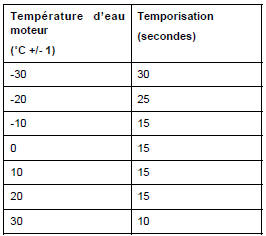
At engine start, power to the heater resistors is allowed after a time delay that depends on engine coolant temperature.
2 - Engine stall protection strategy
When engine speed drops below 800 rpm, operation of the heater resistors is interrupted. When engine speed rises above 875 rpm, operation of the heater resistors is allowed.
Test yourself
A quick Renault Megane quiz: every answer comes with an explanation and a link to the manual page.