Engine and peripherals
Fuel pressure regulator
In this manual: Engine and peripherals
~2min read
Essential equipment |
| diagnostic tool |
| "low torque" torque wrench |
Tightening torques |
|
| regulator screws | 0.6 daN.m |

Before any work on the injection system, use the diagnostic tool to check:
- that the injection rail is no longer under pressure,
- that the fuel temperature is not high.
- Always observe the safety and cleanliness instructions given in this document during every operation.
- Never loosen a high-pressure pipe connection while the engine is running.
- Use the special plug kit for the high-pressure injection circuit.
- Always replace any high-pressure pipe and the high-pressure pipe clips that were removed.
REMOVAL
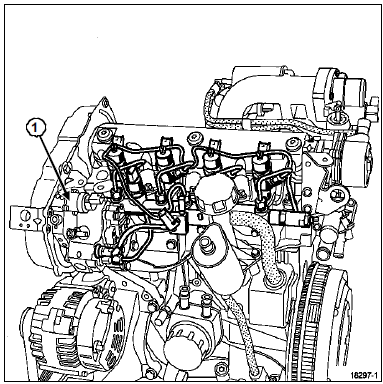
- Disconnect the battery.
- Blow out the area to remove debris around the fuel pressure regulator.
- Disconnect the fuel pressure regulator connector.
- Clean the area with brake degreaser.
- Remove:
- the three fuel pressure regulator screws (1),
- the fuel pressure regulator by hand (do not use a tool as a lever).
INSTALLATION
- Clean the seating face of the fuel pressure regulator on the high-pressure pump, taking care not to introduce any debris.
- Wipe the seating face of the fuel pressure regulator on the high-pressure pump, taking care not to introduce any debris.
- Reconnect the battery.
- Flush the fuel pressure regulator housing in the high-pressure pump by switching the ignition on for a few seconds.
- Disconnect the battery.
- Prepare the new regulator:
- remove the protective cap,
- check the position of the seals,
- lubricate the O-rings with clean diesel.
Note: Lubrication is very important to prevent external leaks.
- Present the regulator with a slight turning movement.
- Push gently until fully seated.
- Pre-tighten the three new regulator screws to 0.3 daN.m.
- Tighten the three regulator screws (0.6 daN.m) to torque using a "low torque" torque wrench.
- Clean the area with cleaning wipes.
- Fit the fuel pressure regulator connector.
Connect the battery; carry out the necessary re-learns (see Electrical Equipment chapter).
- Switch on the ignition.
- Clear any fault indicated in the diagnostic tool if necessary.
Check for diesel leaks:
- run the engine at idle until the radiator fan starts,
- rev the engine several times with no load,
- carry out a road test,
- switch off the ignition,
- check that no diesel is leaking.
Test yourself
A quick Renault Megane quiz: every answer comes with an explanation and a link to the manual page.
Was this page helpful?