ECO*
The ECO function of the Volvo S80 (2nd generation, 2013–2016) allows the driver to actively reduce fuel consumption. This section describes the effects on the engine, transmission and air conditioning, as well as everyday use. The Eco Coast sub-function, which allows the vehicle to coast without engine braking, is also explained. Tips on optimal use and the limits of the function support an environmentally conscious driving style.
ECO13 is an innovative Volvo function for vehicles with automatic transmission that can reduce fuel consumption by up to 5 %, depending on driving behavior. The function helps the driver pay closer attention to environmentally conscious driving.
General
 When the ECO function is activated, the following changes:
- Transmission shift points.
- Engine management and throttle response.
- Start/Stop function - the engine can also be switched off by Auto-Stop when the vehicle is stationary.
- The Eco Coast function is activated - engine braking is disengaged.
- Air conditioning settings - certain consumers are deactivated or run at reduced output.
13 Not possible on XC60 and XC70 with AWD.
CAUTIONWhen the ECO function is activated, certain air conditioning parameters are changed and the functions of certain electrical consumers are restricted. Some settings can be reset manually, but the full range of functions is only restored by switching the ECO function off.
ECO - Operation
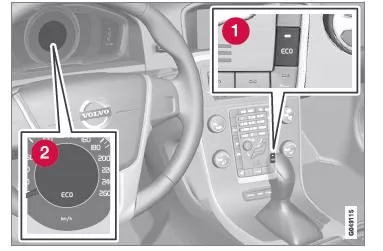
- ECO On/Off
- ECO symbol
Because the ECO function is deactivated when the engine is switched off, the function must be activated again each time the engine is started.
Some engine variants are exempt from this. When the function is active, however, both the ECO symbol in the instrument cluster and the ECO button indicator light up.
ECO function on or off
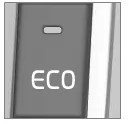 When the ECO function is deactivated, the ECO symbol in the instrument cluster and the ECO button illumination go out. The function remains deactivated until it is switched back on by pressing the ECO button again.
Eco Coast function
The Eco Coast sub-function essentially disables engine braking so that the vehicle's kinetic energy can be used to coast longer distances.
When the driver lifts off the accelerator pedal, the transmission is automatically decoupled from the engine, which then runs at idle speed with minimal consumption.
The function is used when speed reductions are foreseeable, such as when approaching an intersection or a red traffic light.
Eco Coast enables a proactive driving style using the so-called "Pulse & Glide" technique, with as few brake applications as possible.
A combination of Eco Coast and temporarily deactivated ECO function can also reduce fuel consumption. That means:
- Eco Coast activated: Longer coasting without engine braking = lower consumption
and
- ECO function deactivated: Shorter coasting with engine braking = minimal consumption.
To achieve the greatest possible fuel savings, however, Eco Coast should be avoided in combination with short coasting.
Activating Eco Coast
The function is activated when the foot is fully removed from the accelerator pedal and the following conditions are also met:
- ECO button pressed
- Selector lever in D position
- Speed between approx. 65 and 140 km/h
- Road gradient max. approx. 6 %.
Deactivating Eco Coast
Sometimes it may be desirable to deactivate the Eco Coast function.
Examples of this are:
- on steep downhill gradients - to be able to use engine braking.
- before an overtaking manoeuvre - to be able to carry it out as safely as possible.
To deactivate Eco Coast and reactivate engine braking, proceed as follows:
- Press the ECO button.
- Move the selector lever to the manual "S+/-" mode.
- Shift using the shift paddles.
- Operate the accelerator or brake pedal.
Eco Coast - Limitations
The function is not available when:
- cruise control is activated
- the road gradient exceeds approx. 6 %
- manual shifting is performed using the shift paddles*
- the engine and/or transmission are not at their normal operating temperature.
- the selector lever is moved from D to the "S+/-" position
- the speed is outside the range of approx. 65–140 km/h
More information and settings
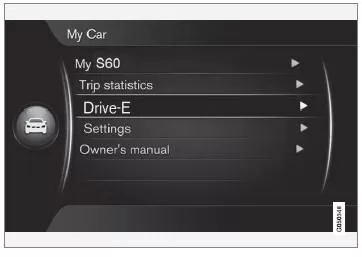
Further information on the ECO concept can be found in the MY CAR menu system of the vehicle - see the MY CAR section.
Related information
- General information on climate control
The ECO function of the Volvo S80 (2nd gen) helps the driver actively reduce fuel consumption. It adapts engine management, transmission shift points and air conditioning to efficient driving. Eco Coast, a function that reduces engine braking, is also activated.
Operation is simple, using the ECO button. The function remains deactivated until the next engine start unless it is activated again. With ECO, Volvo shows how comfort and environmental awareness can be combined.
The system promotes a proactive driving style and makes the S80 an economical companion in everyday use.
Test yourself
A quick Volvo S80 quiz: every answer comes with an explanation and a link to the manual page.