Remote start (ERS) - symbols and messages. Jump starting with battery. Transmission. Manual transmission
If the remote start on the Volvo S80 (2nd generation, 2013–2016) fails or is interrupted, the instrument cluster informs you with symbols and messages. This section shows typical indications and explains how the driver should respond. It also describes jump starting with a battery. Notes on the safe handling of jumper cables and on avoiding short circuits help prevent accidents.
Remote start (ERS) - symbols and messages
In situations where the ERS function fails or is interrupted, a symbol appears in the instrument cluster, supplemented by an explanatory text message.
ERS function not started
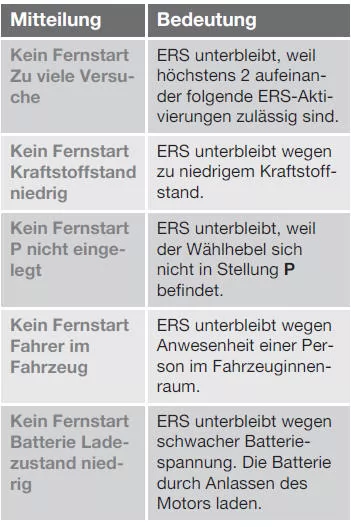

A A Volvo authorised workshop is recommended.
ERS function interrupted

A A Volvo authorised workshop is recommended.
Related information
- Remote start (ERS)*
- Remote Start (ERS) - Operation
Jump starting with battery
If the starting battery is discharged, the engine can be started using the power from another battery.
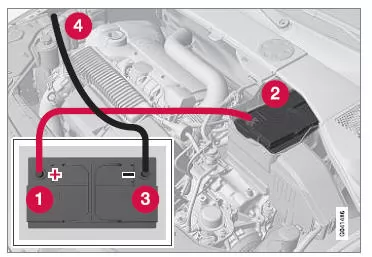
When using another battery to jump start, the following steps are recommended to avoid a short circuit or other damage:
- Set the vehicle's electrical system to key position 0, see Key positions - functions in different stages
- Check that the jump-start battery has a voltage of 12 V.
- If the jump-start battery is installed in another vehicle, switch off the engine of the assisting vehicle and make sure the two vehicles are not touching.
- Connect one clamp of the red jumper cable to the positive terminal (1) of the jump-start battery.
Connect the jumper cable carefully to avoid short circuits with other components in the engine compartment.
- Open the clips on the front cover of the vehicle battery and remove the cover, see Starting battery - replacement
- Connect the other clamp of the red jumper cable to the positive terminal (2) of the vehicle.
- Connect one clamp of the black jumper cable to the negative terminal (3) of the jump-start battery.
- Connect the other clamp to a ground point, e.g. the outer bolt head (4) at the upper edge of the right engine mount.
- Make sure the jumper cable clamps are firmly seated so that no sparks occur during the start attempt.
- Start the engine of the assisting vehicle and let it run for a few minutes at slightly higher speed, approx. 1500 rpm.
- Start the engine in the vehicle with the discharged battery.
Do not touch the connections during the start attempt. There is a risk of sparks.
- Remove the jumper cables in reverse order - first remove the black cable, then the red cable.
> Make sure that none of the clamps of the black jumper cable touch the positive terminal of the battery or the connected clamp of the red jumper cable!
- Starter batteries can produce highly explosive hydrogen gas. A single spark, which can occur if the jump-start cables are connected incorrectly, can cause the battery to explode.
- The starter battery contains sulfuric acid, which can cause severe burns.
- If acid comes into contact with the eyes, skin or clothing, rinse thoroughly with water. If acid splashes into the eyes, seek medical attention immediately!
Related information
- Starting the engine
Transmission
There are two main types of transmission.
Manual transmission or automatic transmission.
- Manual transmission
- Automatic transmission - Geartronic and Powershift
IMPORTANTTo prevent damage to the drivetrain components, the transmission operating temperature is monitored. If there is a risk of overheating, a warning symbol appears in the instrument cluster together with a text message. Follow the recommendation shown in the message.
Related information
- Automatic transmission - Geartronic
Manual transmission
The function of the transmission is to change the gear ratio depending on vehicle speed and power demand.
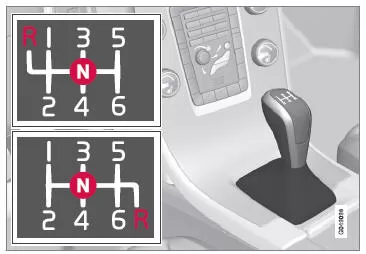
Shift pattern, 6-speed transmission.
The 6-speed transmission is available in two versions, which differ in the reverse gear position. See the shift pattern embossed on the shift lever.
- Fully depress the clutch pedal for every gear change.
- Take your foot off the clutch pedal between gear changes.
When parking on a slope, always apply the parking brake. Engaging a gear is not sufficient to hold the vehicle in all situations.
Reverse gear lock
The reverse gear lock makes it harder to engage reverse by accident during normal forward driving.
- Follow the shift pattern embossed on the shift lever, and move it from neutral N before moving it to position R.
- Engage reverse gear only when the vehicle is stationary.
With the upper version of the 6-speed shift pattern (see previous illustration), first push the selector lever down into position N to engage reverse.
Related information
- Transmission
- Transmission fluid - quality and fill quantity
The ERS system in the Volvo S80 (2nd gen) informs the driver of the status or possible faults via symbols and messages in the instrument cluster. Jump-starting with a battery is also designed for safety: clear instructions minimize the risk of damage or injury.
The manual transmission is precisely engineered and supports efficient driving. Volvo places great emphasis on intuitive operation and the highest safety standards.
FAQ
How do I recognize an interrupted ERS function?
By the corresponding symbols and a text message in the instrument cluster.
What to observe when jump-starting with a battery?
Connect the jump-start cables correctly and avoid creating sparks to prevent short circuits or explosions.
Test yourself
A quick Volvo S80 quiz: every answer comes with an explanation and a link to the manual page.