Automatic transmission - Powershift*
The Powershift transmission in the Volvo S80 (2nd generation, 2013–2016) uses innovative dual-clutch technology that enables fast and efficient gear changes. This section explains how it works, the differences from Geartronic, and important notes on use on slippery roads. It also describes behavior when overheated, including warning signals and recommended measures. Tips for safe use in traffic jams and when towing help ensure system reliability.
The Powershift automatic transmission transmits drive power from the engine to the drive wheels via dual mechanical clutch plates. In contrast to Geartronic, which uses a hydraulic torque converter instead.
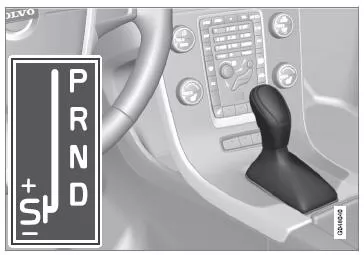
D: Automatic gear positions. +S-: Manual gear positions. S: Sport mode*.
The Powershift transmission works in the same way and has the same controls and functions as the Geartronic automatic transmission.
One exception is the function "Geartronic - winter mode":
- With Powershift, starting off on slippery road surfaces is made easier by manually engaging 2nd gear instead of 3rd gear as with Geartronic.
Towing
Because on models with a Powershift transmission the engine must be running to ensure adequate lubrication of the engine, these vehicles should not be towed. If the vehicle must nevertheless be towed, the distance should be kept as short as possible and the towing should be carried out at very low speed.
If you are not sure whether the vehicle is equipped with Powershift or Geartronic transmission, you can check the transmission sticker under the hood; see type designations.
The designation "MPS6" refers to a Powershift transmission; otherwise it is the Geartronic automatic transmission.
For further important information, see the Towing section.
Please note
The dual clutch of the transmission is equipped with an overload protection that activates when the transmission becomes too hot, for example if the vehicle is held stationary on a hill with the accelerator pedal for too long.
An overheated transmission is indicated by shaking and vibration felt in the vehicle, the warning symbol lighting up, and a message appearing in the instrument cluster. The transmission can also overheat in slow stop-and-go traffic (10 km/h or less) on a hill or when towing a trailer. The transmission cools down when the engine idles at standstill with the brake pedal fully depressed.
Overheating when driving in stop-and-go traffic can be avoided by moving forward in short stages:
- Stop and wait with your foot on the service brake until there is a sufficiently large gap between your vehicle and the vehicle ahead, move forward a short distance, stop, and again wait for a while with your foot on the brake.
Use the service brake to hold the vehicle stationary on a downhill slope - do not hold the vehicle stationary with the accelerator pedal.
Otherwise the transmission may overheat.
Message text and action
In certain situations, the instrument cluster may display a message text while a symbol lights up at the same time.
| Symbol | Message | Driving characteristics | Action |
 |
Transmission hot - Brake and stop | Difficulty maintaining a steady speed at a constant engine speed. | The transmission is overheated. Hold the vehicle stationary with the service brakeA. |
 |
Transmission hot - Park safely - Let engine run | Severe juddering of the vehicle's drive force. | The transmission has overheated. Stop the vehicle safely as soon as possible.A |
 |
Transmission cooling: run engine | No drive due to an overheated transmission. | The transmission has overheated. For rapid cooling: run the engine at idle with the selector lever in N or P until the message goes out. |
A For rapid cooling: run the engine at idle with the selector lever in N or P until the message goes out.
The table shows three levels of increasing severity if the transmission becomes too hot. In addition to the text message, the driver is alerted that the vehicle electronics temporarily change the driving characteristics. Follow the instruction in the text message if applicable.
CAUTIONThe example in the table does not indicate that the vehicle is faulty. It shows that a safety function has been activated to prevent damage to a component of the vehicle.
WARNINGIf the warning symbol together with the text Transmission hot Park safely Keep engine running is ignored, the transmission may become so hot that the power flow between engine and transmission is temporarily interrupted to prevent clutch damage.
The vehicle will then no longer be driven and will remain stationary until the transmission temperature has dropped back to an acceptable level.
For further possible text messages and the corresponding solutions relating to the automatic transmission, see Messages.
A text message clears automatically after the action has been carried out or when the OK button on the turn signal lever is pressed.
Related information
- Automatic transmission - Geartronic*
- Transmission fluid - quality and fill quantity
The Powershift automatic transmission of the Volvo S80 (2nd gen) provides a dynamic driving experience through dual clutch plates and precise gear changes. It combines the advantages of a manual transmission with the comfort of an automatic. Particular attention is paid to protecting the drivetrain and ensuring optimal power transmission.
Caution is required when towing and in stop-and-go traffic to avoid overheating. The clear warning messages and actions in the display help the driver prevent damage to the transmission and maintain its function.
Volvo emphasizes its commitment to quality, safety and durability, which is also reflected in the well-thought-out design of the Powershift transmission.
Test yourself
A quick Volvo S80 quiz: every answer comes with an explanation and a link to the manual page.