Service brake
The service brake of the Volvo S80 (2nd generation, 2013–2016) provides reliable braking force in all conditions. This section explains the function of the brake circuits and the effect of brake booster assistance. Notes on braking behaviour in wet conditions or on road salt, and on maintenance, promote safety. Tips on drying and protecting the brakes after rain or car washing round off the information.
The service brake is used to reduce the speed of the vehicle while driving.
The vehicle is equipped with two brake circuits.
If one brake circuit is damaged, the brake pedal must be pressed harder to achieve normal braking performance.
The driver's pressure on the brake pedal is boosted by a brake booster.
WARNING The brake booster only works when the engine is running.
If the service brake is applied with the engine off, the pedal offers more resistance and greater pedal force is required to brake the vehicle.
On vehicles with Hill Start Assist (HSA)*, the pedal returns to its rest position more slowly than usual when the vehicle is parked on a slope or on uneven ground.
In very hilly terrain or when driving with a heavy load, the brakes can be relieved by using engine braking.
Engine braking is used most effectively when the same gear is selected downhill as was used uphill.
For more general information on severe vehicle use, see Engine oil - severe operating conditions.
Braking in wet conditions
After a long drive in heavy rain without braking, the braking effect may be slightly delayed when the brake is first applied. This can also occur after a car wash. The brake must then be applied more firmly. For this reason, keep a greater distance to the vehicle ahead.
After driving in wet conditions and after a car wash, the brakes should be applied properly. This heats the brake discs, so they dry faster and are protected against corrosion. Pay attention to the traffic situation when braking.
Braking with road salt on the surface
When driving on salted roads, a layer of salt can form on the brake discs and pads. This can lengthen the braking distance. Therefore, keep a particularly large safety distance to the vehicle ahead. Also observe the following:
- Brake occasionally to remove any salt layers. Make sure that no other road users are endangered when braking.
- Apply the brake pedal carefully at the end of the journey and before starting the next journey.
Maintenance
To ensure a continued high level of road safety, operational safety and reliability for your vehicle, follow the Volvo service intervals specified in the Service and Warranty Booklet.
New and replacement brake pads and brake discs only develop their optimum braking performance after a bedding-in period of a few hundred kilometres. Compensate for the reduced braking performance by applying the brake pedal more firmly.
Volvo recommends using only brake pads that are approved for fitting to your Volvo.
IMPORTANTThe brake system components must be checked regularly for wear.
For information on the procedure, contact a workshop or have the inspection carried out by a workshop. A Volvo-authorised workshop is recommended.
Symbols and messages
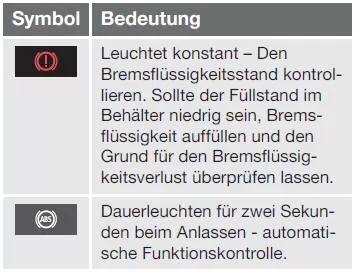
If  and
 illuminate at the same time, a fault may have occurred in the brake system.
If the brake fluid level is normal at this time, drive carefully to the nearest workshop, preferably a Volvo retailer, to have the brake system checked.
If the brake fluid level is below the MIN mark in the brake fluid reservoir, do not continue driving without topping up the brake fluid.
The cause of the brake fluid loss must be checked.
Related information
- Parking brake
- Service brake - Emergency brake lights and automatic hazard warning flashers
- Service brake - Emergency Brake Assist
- Service brake - Braking with anti-lock braking system (ABS)
The service brake of the Volvo S80 (2nd gen) provides reliable deceleration in all conditions. The system is equipped with two brake circuits and is supplemented by brake booster assistance. When the engine is stopped, the brake pedal requires greater pressure.
Important care information, such as drying the brakes after rain or removing salt layers, helps maintain braking performance and service life. Volvo recommends regular maintenance for maximum safety.
FAQ
What to do if the brake system and brake fluid warning symbols illuminate at the same time?
Check the brake fluid level. If the level is normal, drive carefully to the workshop. If the level is low, do not continue driving; top up the brake fluid and have the cause checked.
Why apply the brakes after a car wash?
To dry the brake discs and prevent corrosion.
Test yourself
A quick Volvo S80 quiz: every answer comes with an explanation and a link to the manual page.